Every Indian business above a certain turnover has the same workflow challenge: a deal closes in the CRM, and then someone manually re-enters the same information into Tally or a GST billing tool to generate the invoice. (Zoho solves this natively — see Zoho CRM for GST and invoicing.)
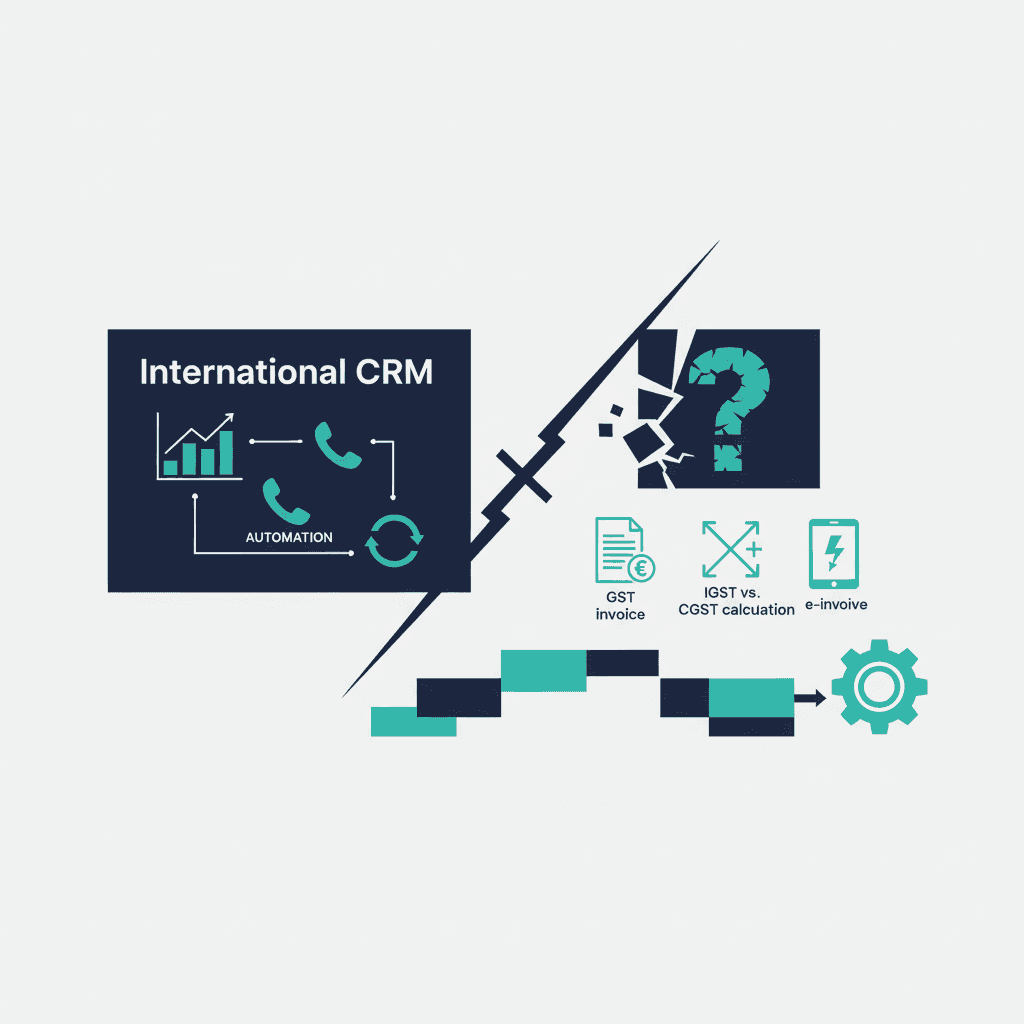
The CRM doesn't know what GST rate applies. It doesn't know whether the transaction is IGST (interstate) or CGST + SGST (intrastate). It doesn't generate HSN or SAC codes. For businesses above $588,235 turnover, it certainly cannot produce the e-invoice format required by the GST portal.
This is not a minor inconvenience. For businesses doing volume, this is 1 to 3 hours per day of manual data re-entry, a consistent source of billing errors, and a compliance risk every time someone forgets to complete the process.
Why international CRMs don't solve this
Salesforce, HubSpot, and Pipedrive were built for Western markets with different tax systems. India's GST framework — with its IGST/CGST/SGST structure, HSN/SAC classification, e-invoice mandate, and GSTR reporting — is highly specific. Building native support for it requires dedicated engineering investment in Indian compliance requirements.
None of the major international CRMs have done this. They leave it to third-party integrations — connectors that sync deal data to Tally, ClearTax, or similar Indian billing tools.
These connectors exist. They work. They also cost money, require setup and maintenance, and introduce another potential point of failure in your billing workflow. When the connector breaks — and integrations break — invoices stop generating until someone diagnoses and fixes it.
The two clean solutions
Solution 1: Zoho's integrated ecosystem
Zoho CRM integrates natively with Zoho Books, which is one of only a few accounting tools certified by India's GST Council. When a deal closes in Zoho CRM, creating an invoice in Zoho Books is a single click — all the customer data, deal value, and product information carries over. Zoho Books handles HSN/SAC codes, calculates the correct GST component based on the customer's state, and generates e-invoices in the format required by the IRP portal.
For businesses starting fresh or willing to migrate: this is the cleanest answer.
Solution 2: CRM + Tally Prime with an API connector
Tally Prime is the most-used accounting software in India, with comprehensive GST support. Modern Tally Prime installations include an API that allows external systems to push invoice data. Several integration tools — including connectors built specifically for Salesforce-to-Tally and HubSpot-to-Tally workflows — are available in the $59 to $235 per year range.
For businesses already using Salesforce or HubSpot with Tally Prime: this extends your existing stack without migration.
The decision businesses keep delaying
The manual re-entry workflow gets treated as acceptable because it works — slowly and inconsistently, but it works. The impetus to fix it usually comes from one of three events: a billing error that causes a client dispute, a tax audit that surfaces inconsistencies between CRM records and GST returns, or a growth inflection where the manual process simply can't keep up with volume.
The fix is cheaper before the event than after it. It's one of several reasons CRM rollouts stall in India — see Why CRM Adoption Fails in Indian Companies. Before spending on marketing to generate more of these records, see The Digital Audit Every Indian SMB Should Run First.
Frequently asked questions
Which CRMs support GST natively for Indian businesses?
Zoho CRM (integrated with Zoho Books, which is GST-certified) is the strongest native option. Leadsquared and Kapture are Indian-built CRMs with built-in GST support. Salesforce, HubSpot, and Pipedrive require third-party Indian billing integrations like Tally Prime, Vyapar, or ClearTax.
What is e-invoicing and does my Indian business need it?
E-invoicing (e-invoice) is the mandatory electronic reporting of B2B invoices to the GST portal for businesses with annual turnover above $588,235 (threshold as of 2024). The invoice must be generated in a specific JSON format, uploaded to the IRP portal, and returned with a signed QR code before sharing with the buyer. No standard international CRM generates this format natively.
How do most Indian businesses currently bridge the CRM-to-billing gap?
Three common approaches: use Zoho's integrated ecosystem (CRM + Books); export deal data from the CRM and manually enter it into Tally or a dedicated GST billing tool; or use a connector that syncs closed deals from the CRM to a GST-compliant billing tool automatically. The manual approach is the most common and the most error-prone.
Is it worth switching CRMs just for GST integration?
Not if your current CRM is working well for sales management. It's worth adding a GST-compliant billing tool that connects to your CRM. The switching cost of a CRM migration typically exceeds the integration cost significantly. Evaluate native GST support as a primary criteria if you're choosing your first CRM.
Yash
Founder & Principal Consultant, Ynexgen
Yash leads Ynexgen, helping small and mid-sized businesses turn technology into a stronger foundation for growth — 7+ years across Salesforce CRM, websites, and AI adoption.