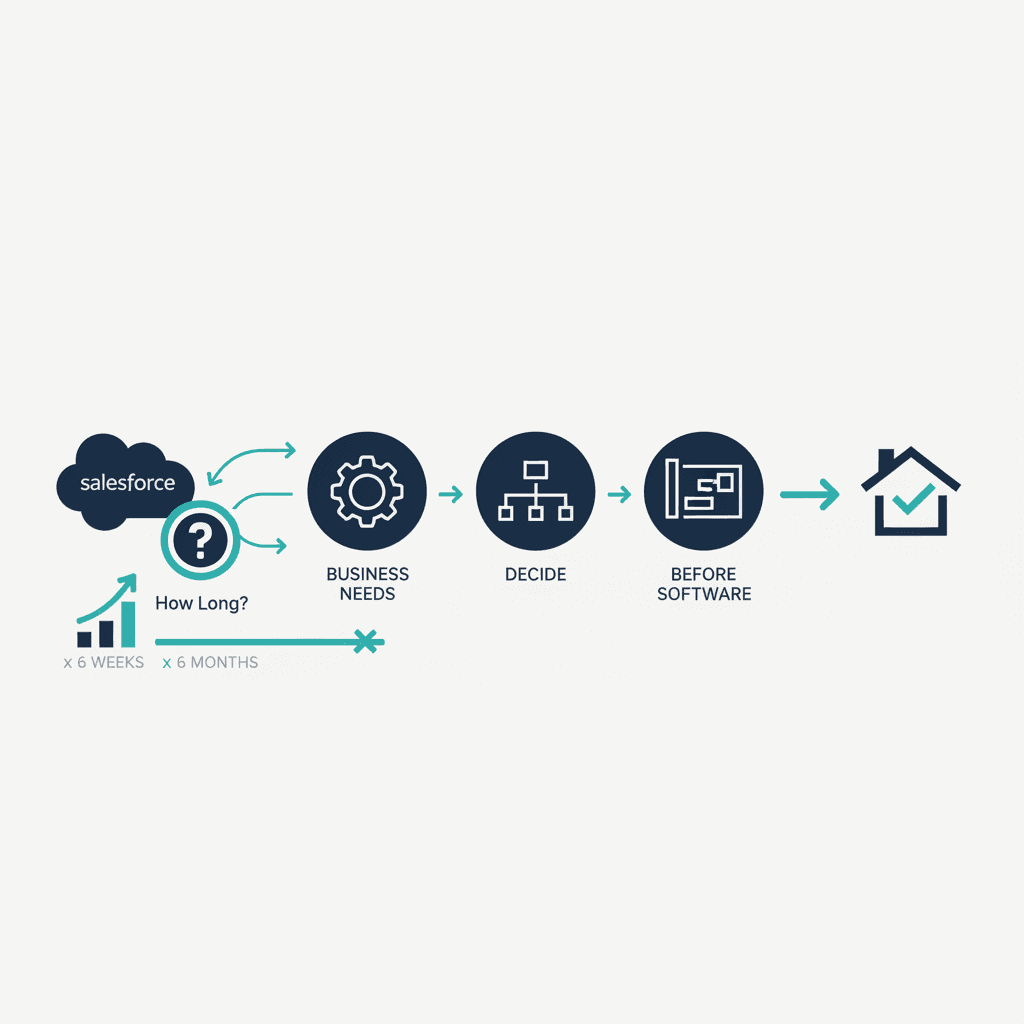
When you ask a Salesforce sales rep how long implementation takes, they'll say six to eight weeks. When you talk to someone who's done it, they'll say it depends — which is true, but not helpful. (Already implemented and want to know if it's healthy? See our Salesforce org health check.)
Here's a more honest framework.
Want your number instead of a framework? The free Salesforce implementation timeline estimator turns five questions about your team, data and integrations into a phase-by-phase timeline — no signup.
The three factors that determine your timeline
1. How complex is your sales process?
A simple pipeline — lead comes in, rep follows up, deal closes or doesn't — takes weeks to set up. A process with multiple product lines, different stages per territory, approval gates before discounts, and integrations with your ERP takes months. Neither timeline is wrong; they're just different projects.
2. How clean is your existing data?
Data migration is where most implementations hit unexpected delays. If your current contacts are spread across spreadsheets, an old CRM, and three people's personal email accounts — and half the records have missing fields, duplicate entries, or outdated information — you're adding four to eight weeks of cleanup before anyone touches Salesforce itself.
3. How much training does your team need?
A 5-person team that's used another CRM before? A few sessions. A 30-person team that's been on spreadsheets for a decade? You need a proper change management plan, a Salesforce champion inside the business, and phased rollout to avoid overwhelming people all at once.
Realistic timelines by scope
Quick-start (4–6 weeks): Standard CRM setup, one sales pipeline, contact import, basic reports, team training. Works for businesses under 10 users with straightforward processes. Typically costs $5,000 to $20,000.
Standard implementation (8–16 weeks): Custom fields and objects, multiple pipelines, workflow automation, email integration, basic dashboards. Most SMBs with 10 to 50 users fall here. Typically costs $20,000 to $75,000.
Complex implementation (4–9 months): Custom development, multi-system integrations (ERP, financial software, marketing platforms), territory management, advanced forecasting, change management programme. Enterprise-scale teams. Typically costs $75,000 to $300,000+.
Where the timeline actually breaks down
The number one cause of delays isn't technical — it's decision-making. An implementation can sit in limbo for three weeks because nobody can agree on what the pipeline stages should be called. Or what counts as a qualified lead. Or who owns the data after the old system is decommissioned.
These sound like small decisions. They're not. They shape how your entire sales team works for the next five years.
Before any implementation starts, the business should have documented answers to: what are our pipeline stages, who owns each stage, what data do we need on every contact, what does done look like for a deal?
The 90-day rule
Go-live is not the finish line. The first three months after go-live are when implementations succeed or die. If nobody logs into Salesforce during week two because the old spreadsheet is easier, the project has failed regardless of how well it was configured.
The businesses that get lasting value from Salesforce designate one internal person as the Salesforce owner before the project starts — someone whose job it is to enforce adoption, answer questions, and push for the changes that make the tool more usable over time. No tool survives without an internal champion. That champion also needs to know the common failure points — see 5 Salesforce Mistakes Small Businesses Make.
Frequently asked questions
What is the fastest possible Salesforce implementation?
A quick-start implementation — basic CRM setup, contact import, one pipeline, and light training for a small team — can be done in 4 to 6 weeks. This is realistic for businesses with simple sales processes and under 10 users.
Why do Salesforce implementations run over time and budget?
The most common reasons: scope creep (adding features mid-project), poor data quality in the existing system requiring cleanup, unclear requirements at the start, and low user adoption requiring extra training. Fixing all three before you start dramatically improves outcomes.
Should I hire a Salesforce partner or do it in-house?
For most SMBs, a certified Salesforce partner is worth the cost. The implementation fee is often recovered within 3 months through better adoption and setup. In-house implementations frequently take 2x longer and result in configurations that need to be redone.
What happens after go-live?
The first 90 days post-go-live are critical. You need a dedicated person monitoring adoption, fixing workflow issues, and running short training refreshers. Most implementations that fail do so in this window — the software works, but people stop using it.
Yash
Founder & Principal Consultant, Ynexgen
Yash leads Ynexgen, helping small and mid-sized businesses turn technology into a stronger foundation for growth — 7+ years across Salesforce CRM, websites, and AI adoption.