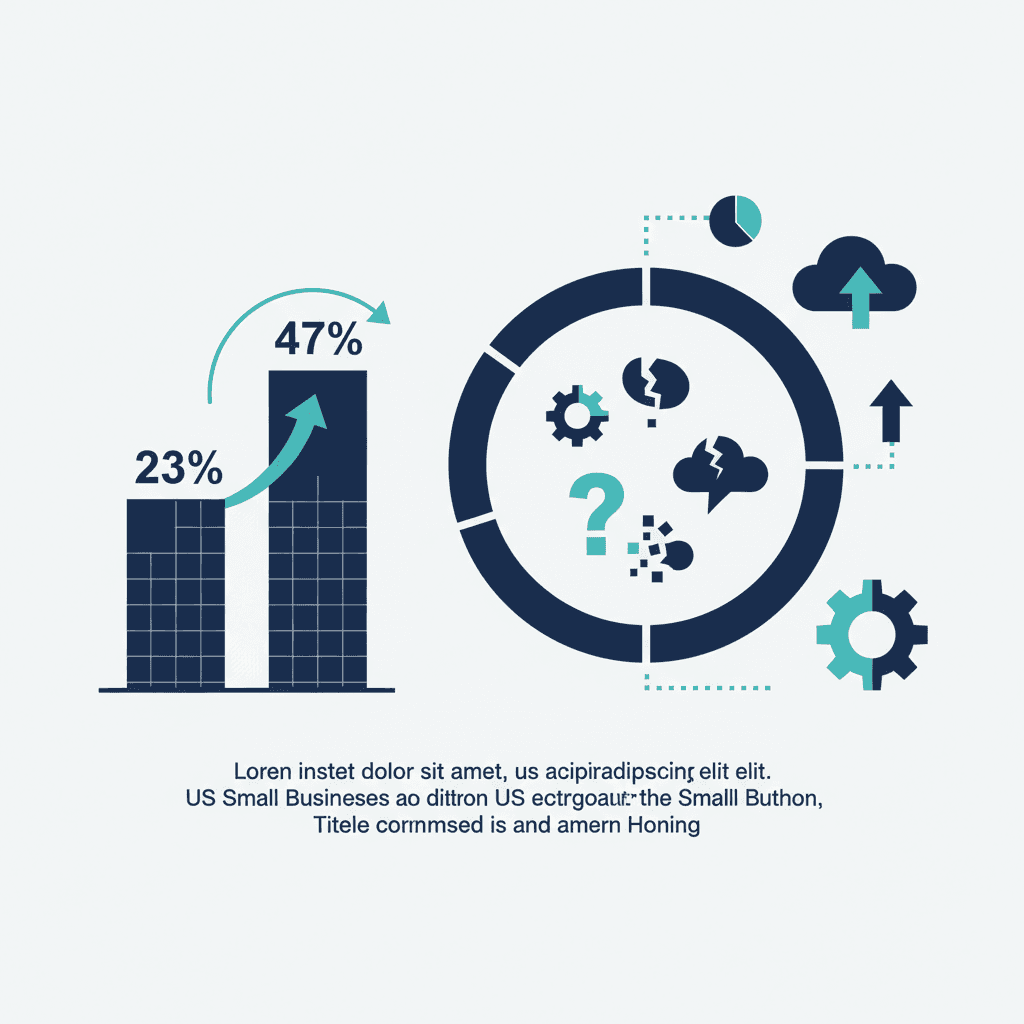
In 2023, 23% of US small businesses used AI in some form. By 2025, that number was 47%. (If you're in the half still waiting, start with what AI consulting is and the tasks worth automating.) The Federal Reserve and US Census data both confirm the direction: AI adoption among small businesses is accelerating faster than any technology since mobile.
And yet more than half of US small businesses still haven't meaningfully adopted it. The question worth asking is: why?
The stated reasons vs. the real reasons
Survey data on non-adoption is instructive. Among businesses with fewer than five employees, 82% say "AI is not applicable to my business." Among businesses with 5 to 20 employees, the most common reason is "lack of technical expertise" — cited by 45% of non-adopters. "Difficult to choose the right tools" runs at 47%.
These are honest answers. They're also answers that reflect a misunderstanding of what AI actually requires.
"AI is not applicable to my business" almost always means "I cannot imagine a specific use case." This is a familiarity problem, not an applicability problem. Any business that writes proposals, answers customer emails, schedules appointments, or summarizes meetings has applicable use cases. That's most businesses.
"Lack of technical expertise" reflects the assumption that AI requires technical knowledge to use. For the tools that deliver immediate value to small businesses — ChatGPT, Claude, Gemini, AI-enhanced email and scheduling — the technical barrier is approximately the same as learning a new mobile app. It takes an afternoon.
What the adopters are actually doing
The 14% of small businesses that have AI fully embedded in core operations aren't running machine learning infrastructure. They've built habits around a handful of tools:
A general-purpose AI for writing, editing, and research. An AI-enhanced email client for drafting and summarizing. An automation tool (Zapier or Make) connecting their existing software. In some cases, an AI assistant embedded in their CRM.
That's the stack. Total monthly cost: $60 to $150. Hours saved per week: 5 to 15. Productivity gained: equivalent to adding a part-time administrative employee.
The cost of waiting
The gap between AI adopters and non-adopters is compounding. Businesses that started using AI in 2023 have two years of workflow efficiency and institutional habit built up. Businesses starting in 2026 face a steeper learning curve as the tools have evolved, and they're starting behind competitors who've already optimized their processes.
This is not a crisis. The tools are more accessible now than they've ever been. But "we'll look at it when things slow down" is a decision that tends to get revisited only when a competitor starts delivering faster, cheaper, or at higher volume using tools you decided to wait on.
The barrier isn't technical expertise. It's a Saturday afternoon and a decision to start with one use case. See AI Tools Small Business Owners Are Actually Worth Paying For for where to point that Saturday afternoon.
Frequently asked questions
Which industries have the highest AI adoption among US small businesses?
Professional services (consulting, legal, financial), technology, and marketing-adjacent businesses lead adoption. Industries with less adoption include construction, trades, and businesses with primarily field-based workforces — though AI scheduling and quoting tools are changing this.
What are the actual productivity gains US small businesses see from AI?
91% of SMBs using AI report revenue improvements, and 86% report improved profit margins. However, only 14% say AI is fully embedded in core operations — meaning most are seeing early-stage gains from simple use cases like writing and scheduling, not from deeper workflow automation.
How much does it cost a US small business to start using AI?
The entry cost is low: $20/month for ChatGPT Plus or Claude Pro covers most early use cases. Adding workflow automation (Zapier or Make) runs another $20–$50/month. Total first-year cost: $500–$1,000. Most businesses recover this in the first month through time savings alone.
Is AI actually applicable to businesses with fewer than 5 employees?
Yes, but the use cases are different. For micro-businesses, AI's value is as a one-person leverage tool — handling writing, research, customer communication, and scheduling at the speed of a larger team. 82% of non-adopters in this size bracket cite 'not applicable to my business' as the reason — a misperception that's costing them time.
Yash
Founder & Principal Consultant, Ynexgen
Yash leads Ynexgen, helping small and mid-sized businesses turn technology into a stronger foundation for growth — 7+ years across Salesforce CRM, websites, and AI adoption.