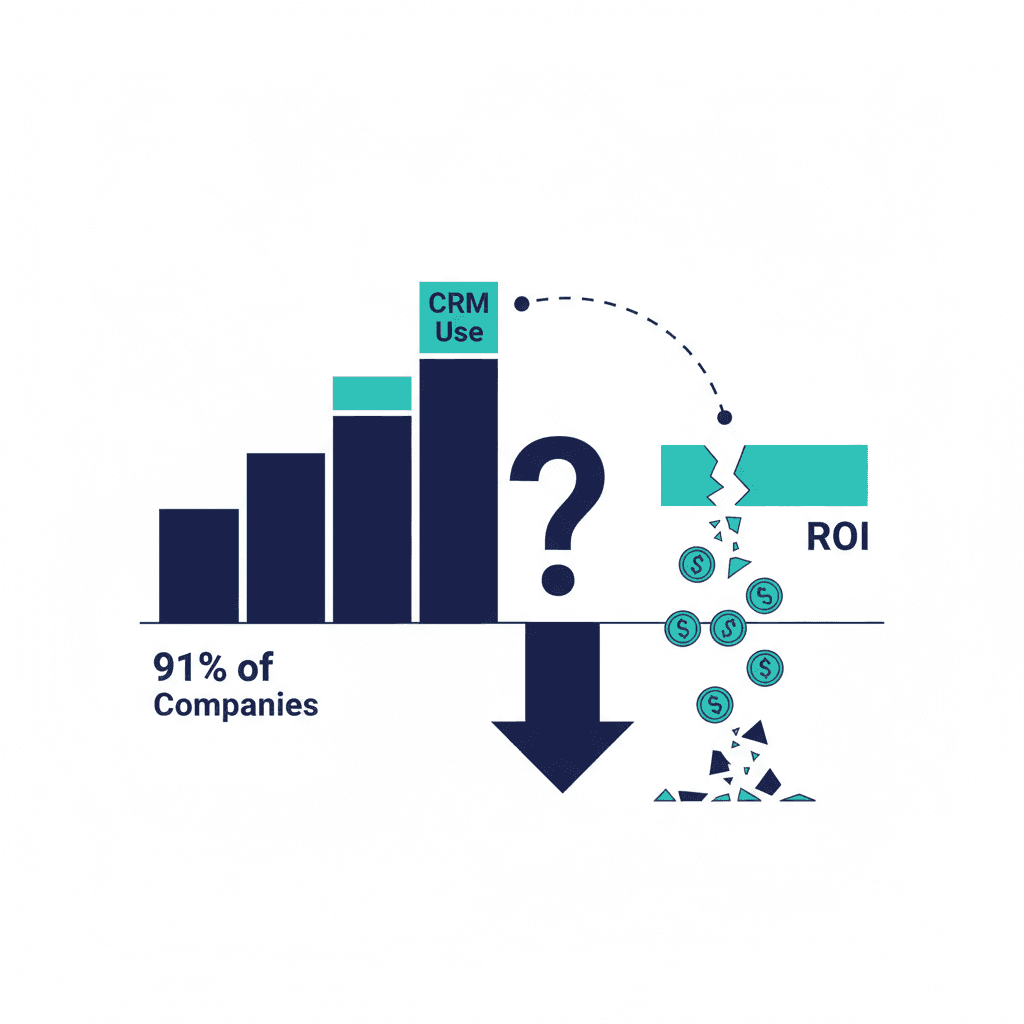
91% of companies with more than 11 employees now use a CRM. That number keeps climbing, and it should — CRM is genuinely one of the highest-ROI software categories when it works. When it doesn't, it's a subscription that generates reports nobody trusts.
The gap between "we have a CRM" and "our CRM drives real business results" is where most of the money disappears. Here's what the data shows.
The adoption paradox
CRM adoption is high. CRM utilisation is not.
A business can have 100% licence deployment and 20% actual usage — the same pattern examined in why CRM adoption fails in Indian companies. Sales reps have logins they use occasionally. The manager pulls reports that don't reflect real pipeline activity because the underlying data was entered grudgingly and infrequently. Decisions still get made from memory and instinct, with the CRM report as a formality rather than an input.
This isn't a technology failure. The technology works fine. It's an adoption failure — and 43% of organisations that fall short of their CRM ROI goals cite adoption as the primary cause.
What separates high-ROI from low-ROI implementations
Data quality comes before everything else. A CRM filled with inaccurate, incomplete, or outdated records produces misleading reports. Misleading reports produce bad decisions. Bad decisions erode trust in the CRM. Reduced trust produces less diligent data entry. This spiral is self-reinforcing.
The businesses that get strong CRM ROI treat data quality as a non-negotiable operational standard, not a nice-to-have. They audit their CRM records quarterly. They have defined rules for what constitutes a complete contact record and a complete deal record. They measure data completeness alongside revenue metrics.
The CRM must be the system of record, not one of several. If the sales team has the CRM and a shared spreadsheet and a WhatsApp group and personal notes and can choose which one to update on any given day, the CRM will be the lowest-quality record because it has the most friction. When the CRM is the only place the business looks for pipeline information — in every meeting, in every report — data quality follows.
Adoption requires the tool to serve the person entering data, not just the person reading reports. This is the most underrated factor. A salesperson who enters data into a CRM they never personally benefit from is doing administrative work for their manager. A salesperson who looks at their own CRM dashboard to prioritise tomorrow's calls is using a tool that serves them. The second person updates their CRM more accurately and more consistently, for self-interested reasons.
What the ROI data actually shows
For businesses that achieve strong adoption — defined as 80%+ of team members logging activity daily — the outcomes are measurable:
- Forecast accuracy improves by 42% because pipeline data is current rather than reconstructed
- Sales cycle length decreases by 14% through consistent follow-up and no leads falling through
- Administrative time drops by 5 to 6 hours per week per salesperson through automation of routine logging
The businesses in the bottom quartile of CRM ROI share a common profile: they implemented the tool, ran one round of training, and assumed adoption would follow. It doesn't. Adoption is a management problem that requires ongoing attention, not a one-time training problem.
The businesses in the top quartile decided, before they went live, that the CRM would be the only accepted source of pipeline truth — and made their management behaviour reflect that decision. See Your CRM Is Not Your Problem for what that management behaviour actually needs to look like.
Frequently asked questions
What percentage of CRM implementations actually fail?
Estimates vary between 30% and 70% depending on how failure is defined. Using the most practical definition — the business doesn't see measurable ROI improvement within 18 months — the failure rate is around 40 to 50%. The most common single cause across all studies is poor user adoption.
What does good CRM ROI actually look like for a small business?
For a 10-person sales team, a well-implemented CRM typically reduces administrative time by 5 to 8 hours per week per person, increases pipeline forecast accuracy by 30 to 40%, and improves close rates by 10 to 15% through consistent follow-up. Combined, this represents significant value — but only if the data is clean and adoption is high.
Is it possible to measure CRM ROI before full implementation?
Yes. The baseline metrics to capture before launch: average deal cycle length, current close rate on qualified leads, hours per week spent on CRM-adjacent admin tasks, and number of leads lost to follow-up failure in the last quarter. Measure the same things at 6 months and 12 months post-launch.
What's the most underrated thing businesses can do to improve CRM ROI?
Run every pipeline review from CRM data and never from a separate spreadsheet or memory. This single change, consistently maintained, forces data quality improvement faster than any amount of training. People update the CRM when they know it's the source of truth in the meeting.
Yash
Founder & Principal Consultant, Ynexgen
Yash leads Ynexgen, helping small and mid-sized businesses turn technology into a stronger foundation for growth — 7+ years across Salesforce CRM, websites, and AI adoption.