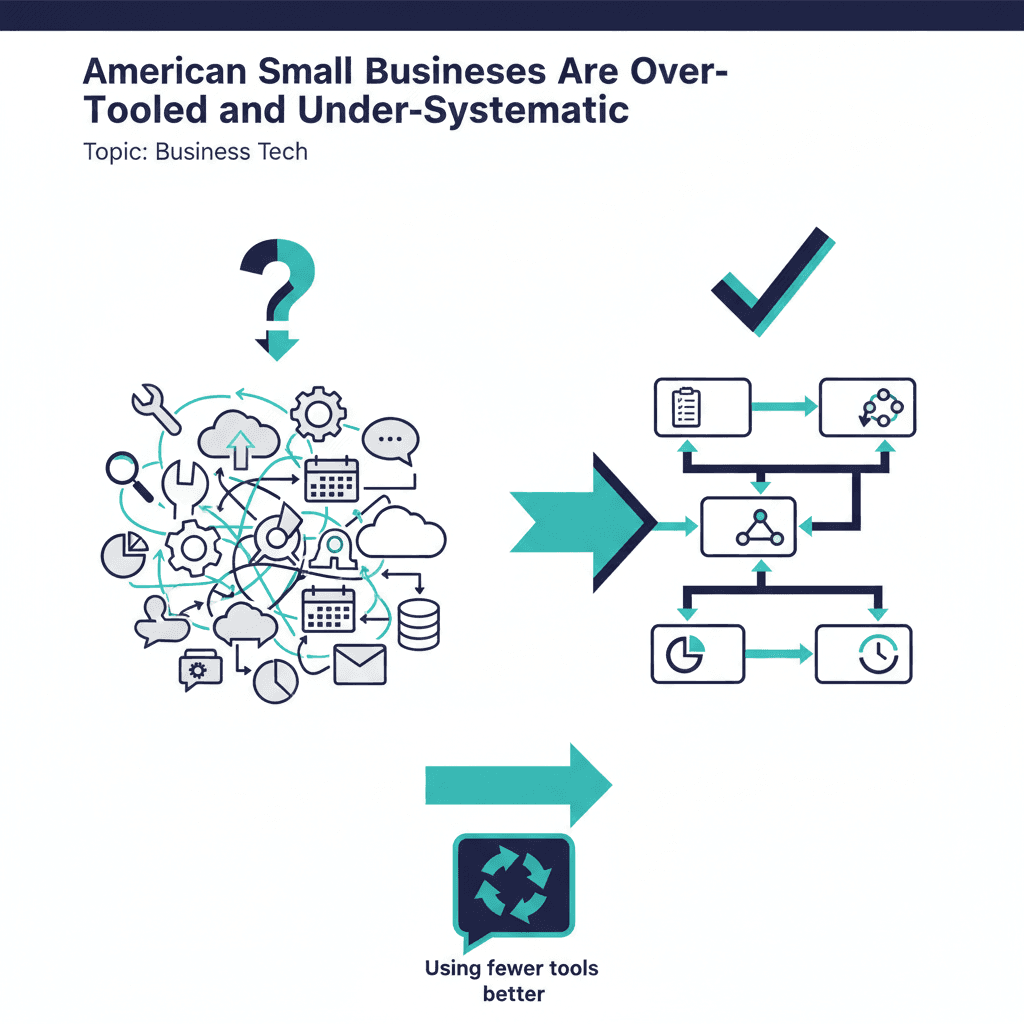
The productivity technology market has created a peculiar problem for American small businesses. There has never been more tooling available at lower cost. And small businesses have never been less systematic about the work those tools are supposed to support.
The average US company — across all sizes — now runs 254 SaaS applications. For small businesses the number is lower but the pattern is the same: tools accumulate. They get added to solve a specific problem, become semi-adopted, never get retired, and quietly drain $50 to $500 per month each while generating overhead nobody accounts for.
The irony is that the businesses spending the most on productivity tools are often the least productive. Not because the tools are bad, but because having eight overlapping tools for customer communication, three competing project management systems, and four ways to schedule a meeting means nobody knows which one is authoritative, training is constant, and every new hire spends their first month learning which tools are actually used versus which are supposed to be used.
The tool acquisition loop
Here's how it happens. A business has a problem — say, sales follow-up is inconsistent. Someone researches solutions, finds a tool, gets a trial, and adopts it partially. Three months later, follow-up is still inconsistent because the tool wasn't the problem. Someone researches again, finds a different tool, gets a trial. Now there are two tools. Neither is used consistently. The problem persists.
The follow-up inconsistency was a process problem and a management accountability problem. No tool solves those. Tools can enforce process once it exists. They cannot create it.
What systematic actually looks like
The businesses that are genuinely productive — not the ones with the most tools, but the ones where work consistently gets done and information consistently gets where it needs to go — share a characteristic: they have deliberately chosen a small set of tools, documented how those tools are used, and made non-compliance with the system visible.
One CRM. One project management tool. One communication platform. One document repository. Everything else is considered carefully before being added, and something is retired for every new tool brought in.
This sounds simple. In practice it requires resisting every demo that looks good, every referral from a peer that swears by a new tool, every competitor that seems to be using something you're not. The discipline of not adding is harder than the discipline of adopting.
The most productive thing most US small businesses could do this quarter isn't finding a better tool. It's removing three tools they're paying for and not using, and systematizing the ones that remain — the same discipline behind building AI habits before buying more tools. See AI Tools Small Business Owners Are Actually Worth Paying For for how to tell which three to keep.
Frequently asked questions
How many SaaS tools does the average US small business actually use?
Research puts the average at 254 applications across a business — though most small businesses actively use a much smaller subset. The number reflects the accumulation of free trials, department-level purchases, and tools added to solve one-off problems that were never retired.
How do I audit the tools my business is paying for?
Pull your business credit card and bank statements for the past 12 months and list every recurring software charge. For each one, identify who uses it, how often, and what would break if you cancelled it. Most businesses find 20–40% of their SaaS spend on tools that could be cut or consolidated without meaningful impact.
What's the most common result of SaaS consolidation for small businesses?
Lower cost and higher adoption. When a business consolidates from four overlapping tools to one that does the job well enough, the team actually uses it. Paradoxically, a less feature-rich tool with 80% adoption delivers more value than a comprehensive platform with 20% adoption.
When is adding a new tool justified?
When it replaces something you're currently doing manually (time recovered), replaces a worse tool doing the same job (upgrade), or adds a capability you've already identified as a growth bottleneck (new function). Not when it looks impressive in a demo or comes with a good referral. Every tool adds a learning curve and integration overhead — only add it when the benefit is concrete.
Yash
Founder & Principal Consultant, Ynexgen
Yash leads Ynexgen, helping small and mid-sized businesses turn technology into a stronger foundation for growth — 7+ years across Salesforce CRM, websites, and AI adoption.