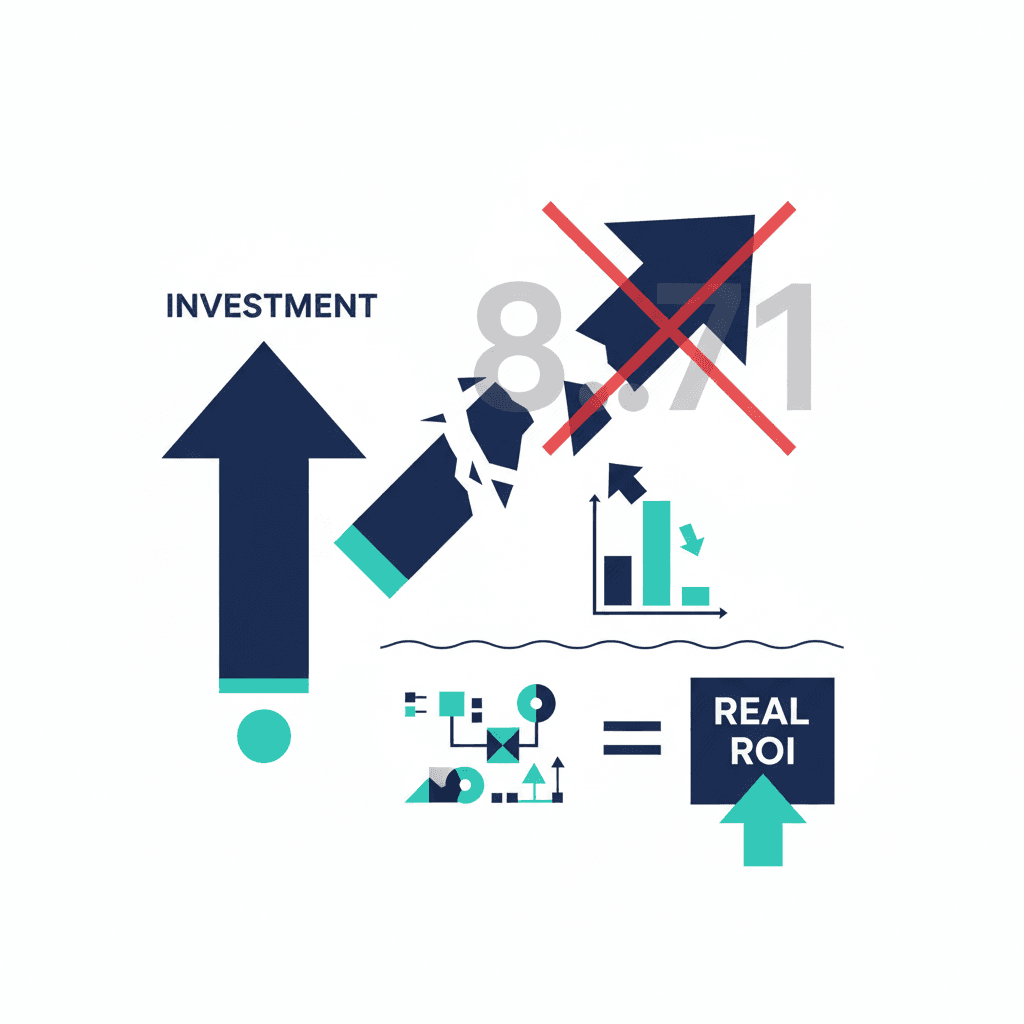
There is a number that appears in nearly every CRM vendor's marketing material, every CRM comparison article, and most sales decks: $8.71 return for every $1 spent on CRM.
It is cited as if it were a law of physics. It is not. (91% of companies use a CRM — most still don't see this kind of return.) It is a 12-year-old statistic from a study methodology that no longer reflects the cost structure of modern CRM deployment.
Here's what happened, and what the real numbers look like.
Where the $8.71 came from
Nucleus Research published a CRM ROI benchmark in 2014. The study found that, across the organizations they analyzed, CRM delivered $8.71 in return for every dollar spent. This was widely circulated, entered the standard CRM sales narrative, and has been repeated verbatim ever since.
In 2023, Nucleus Research revisited the analysis with updated cost and benefit data. Their revised figure: approximately $3.10 per dollar spent. A 64% reduction. This revision received a fraction of the attention the original figure got, which is how marketing works.
The decline reflects a real change: CRM costs have increased substantially since 2014. Salesforce Enterprise pricing has risen multiple times. Implementation partner rates have roughly doubled. The platforms do more, but they also cost significantly more, compressing the ROI ratio.
What $3.10 actually means
A $3.10 return per dollar is still a strong investment — most capital expenditures don't return 3x. But it changes how you should think about the business case.
At $8.71 per dollar, a $50,000 first-year CRM investment returns $435,500 in value. You can afford to be loose with the assumptions.
At $3.10 per dollar, the same investment returns $155,000 in value. The math still works, but the margin for error is much smaller. Poor adoption, a slow implementation, or a mismatch between the platform's strengths and your actual workflow can easily push you below breakeven.
What honest CRM ROI looks like for a US small business
For a 10-person sales team on a mid-tier CRM platform — HubSpot Professional or Salesforce Pro Suite — realistic year-one economics:
Costs:
- Licenses: $18,000–$30,000/year
- Implementation: $15,000–$40,000 one-time
- Internal admin time: 3–5 hours/week × $75/hour burdened cost = $11,700–$19,500/year
- Year-one total: $44,700–$89,500
Benefits (with 75%+ adoption):
- Admin time saved per rep: 5 hours/week × 10 reps × $50/hour = $130,000/year
- Close rate improvement (17% increase on $1M pipeline): $170,000/year
- Deal leakage reduction (10% of leads recovered at $5,000 avg value): $50,000/year
- Annual benefit: ~$350,000
That's roughly a $3.90 return per dollar — in line with the revised Nucleus figure, and achievable with disciplined implementation.
The businesses that don't see it are almost always missing one of two things: adoption above 75% (see why CRM adoption fails), or clean enough data for the reporting to mean anything. Fix those two problems and the ROI follows. Skip them and no ROI figure is going to save the investment. The same measurement discipline applies to AI tools — see How to Measure AI Automation ROI for a comparable framework.
Frequently asked questions
What is the actual ROI of a CRM for a small US business in 2026?
The honest range is $3 to $5 return per $1 spent over a 3-year period, per Nucleus Research's 2023 revision. For businesses with strong adoption and clean data, ROI can exceed this. For businesses with poor adoption — the majority — it falls well below it.
Why do CRM vendors keep quoting the $8.71 figure?
Because it's the highest credible number from a real research firm and it hasn't been publicly corrected by that firm with the same fanfare. Marketing materials rarely update their statistics when the news gets worse.
What's a realistic CRM budget for a 10-person US service business?
License costs of $1,500 to $10,000 per year depending on platform. Implementation costs of $5,000 to $40,000. First-year total: $6,500 to $50,000. Expect 12 to 18 months to break even. Businesses that expect faster returns are typically disappointed.
How do I calculate CRM ROI for my own business before buying?
Estimate three things: hours per week saved on admin (at your hourly rate), improvement in close rate on qualified leads (in dollars), and reduction in deal leakage. Add them up annually. Compare to total year-one CRM cost. If the number is positive within 18 months, proceed. If not, revisit the platform or the scope.
Yash
Founder & Principal Consultant, Ynexgen
Yash leads Ynexgen, helping small and mid-sized businesses turn technology into a stronger foundation for growth — 7+ years across Salesforce CRM, websites, and AI adoption.