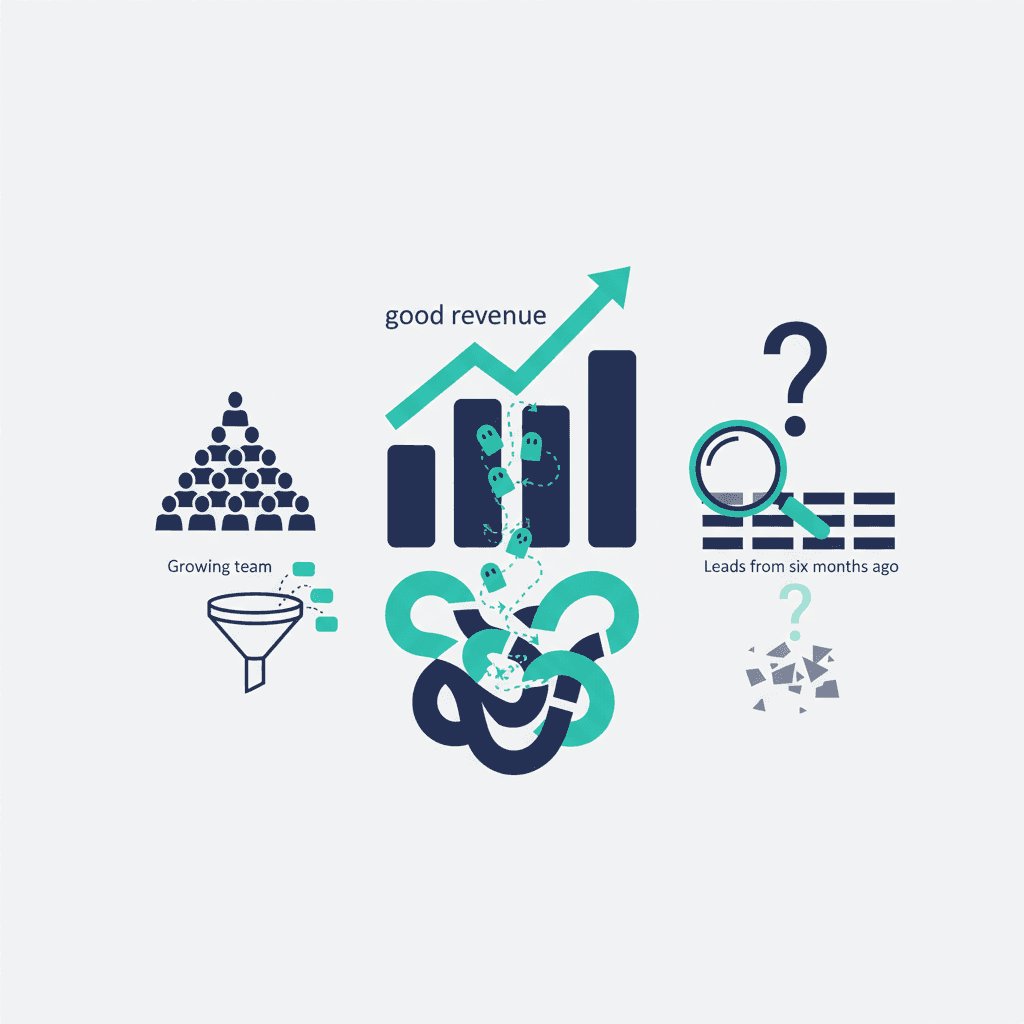
The managing director of a 15-person consulting firm asked his team a simple question during a strategy meeting: "What happened to the leads we got in January?"
Nobody could answer it completely. (This is exactly the gap real CRM ROI closes — see the CRM ROI number you've been quoted is wrong.)
The sales lead remembered two or three. The BD manager found a few in her email. Someone else had a list in a spreadsheet that hadn't been updated since March. By the end of the meeting they'd reconstructed about half of January's leads. For the other half, there was no record of what happened — whether they'd been followed up, whether they'd gone to a competitor, whether they were still waiting for someone to call.
This wasn't a struggling business. Revenue was growing. The team was capable. The pipeline looked healthy in any given week because the focus was always on the deals that were actively progressing. The deals that had gone quiet just quietly disappeared.
What the audit found
It took three weeks to properly reconstruct six months of lead history from email threads, WhatsApp messages, spreadsheets, and memory. What they found:
Of every 10 qualified leads that came in, roughly 3 had been followed up fewer than twice before going quiet. Of those, at least 1 had later gone to a direct competitor — they found out from a mutual contact.
On an annualised basis, this was roughly $52,941–$70,588 in potential revenue that had evaporated not because they lost the pitch, but because no one followed up at the right moment.
Nobody was to blame in the way you'd normally assign blame. The sales team was diligent about the deals they knew were live. The problem was that once a prospect went quiet for two weeks, it fell off the radar entirely. There was no system to surface it again.
The fix wasn't complicated
They implemented a CRM — not an enterprise platform, just HubSpot Starter — and migrated every active and recent lead into it over a week. Each deal got an owner, a last-contact date, and a scheduled next action.
They ran their pipeline review from the CRM from the following Monday. Deals with no activity in 14 days turned orange. Deals with no activity in 21 days turned red. The colour made silent deals visible for the first time.
In the first month, three deals came back that had been effectively abandoned. Two converted. The combined value was larger than three months of CRM subscription costs.
What this actually measures
The managing director put it well in a follow-up conversation: "We weren't bad at sales. We were bad at memory. The CRM didn't make us better salespeople — it just stopped us from forgetting things."
That's the most accurate description of what a CRM does for a small business. It's not a closing machine. It's a memory system. And the cost of not having one isn't paid all at once — it's paid slowly, in deals that go cold and enquiries that go unanswered, in a way that's almost impossible to see until you go looking. Start looking with Signs Your Website Is Costing You Customers.
Frequently asked questions
How common is invisible deal leakage?
More common than most businesses want to believe. Without a CRM with pipeline visibility, the average business loses track of 20 to 30% of qualified leads — not to competition, but to simple follow-up failure. The leads expressed interest and then nobody followed up at the right time.
How do you measure deal leakage if you don't have a CRM yet?
Start simple: export every lead inquiry from your email in the last 6 months. Cross-reference with closed deals. The gap — inquiries with no outcome recorded — is your floor estimate of leakage. For most businesses doing this for the first time, the number is uncomfortable.
What's the fastest way to fix deal leakage without implementing a full CRM?
A simple shared spreadsheet with five columns — name, inquiry date, last contact date, status, and next action — and a weekly 20-minute review can reduce leakage significantly in the short term. It's not scalable, but it's better than nothing while you evaluate CRM options.
At what point does deal leakage cost more than a CRM?
If your average deal value is $2,353 and you're losing three deals per quarter to follow-up failure, that's $7,059 in annual leakage. A CRM with proper pipeline management costs $141 to $353 per user per year. The math is usually clear within the first calculation.
Yash
Founder & Principal Consultant, Ynexgen
Yash leads Ynexgen, helping small and mid-sized businesses turn technology into a stronger foundation for growth — 7+ years across Salesforce CRM, websites, and AI adoption.