At Salesforce's Dreamforce 2024, they announced Agentforce as the future of the platform. By 2026, it's embedded across every tier of Salesforce and generating more questions from business owners than anything else in the product.
Most of those questions start the same way: "I've read the website three times and I still don't know what it does."
So here's the plain version. When you're ready to act on it, work the Agentforce readiness checklist and weigh the cost for a small business.
What Agentforce actually is
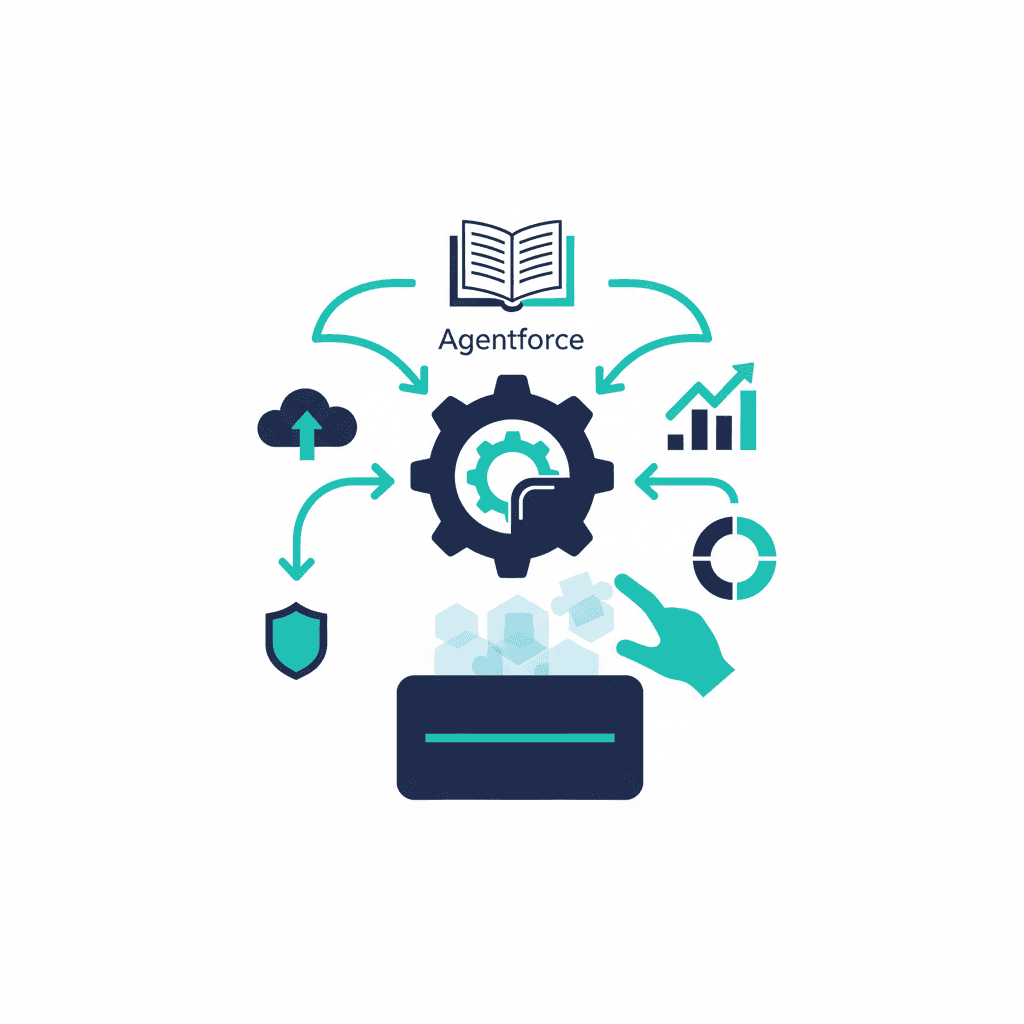
Agentforce is an AI that can take actions inside Salesforce on behalf of your customers and your employees — not just answer questions, but do things.
A regular chatbot reads from a script. You write the questions and the answers, and when a customer asks something you didn't script, the bot fails.
Agentforce is connected to your Salesforce data in real time. When a customer asks "what's the status of my order," it doesn't look up a scripted answer — it checks the actual order record in your system and responds with the real status. When a customer says "I need to rebook my appointment," it can access your calendar integration, find an open slot, and book it. When a complaint escalates beyond its ability to handle, it routes to a human agent with full context of what already happened.
It resolves 66% of inquiries autonomously, according to Salesforce's own data. The most mature deployments handle 6,000 simultaneous interactions.
The three things it's most commonly used for
Customer service deflection. This is where most businesses start. Agentforce handles tier-one support — account questions, order tracking, basic troubleshooting, appointment changes — automatically, 24 hours a day. One mid-market B2B firm reduced support operating costs by 30% within six weeks of deployment.
Sales development. Agentforce can qualify inbound leads, ask discovery questions, and score them based on your defined criteria before routing to a human rep. Salespeople spend less time on bad-fit leads and more time on prospects that are actually likely to buy.
Internal knowledge assistance. Staff can ask Agentforce questions about internal processes, product specs, or customer history instead of digging through documentation or waiting for a colleague to respond. This is underrated — it surfaces institutional knowledge that would otherwise live in people's heads.
What it costs and when it makes sense
Agentforce pricing starts at roughly $2 per conversation, with credit-based Flex pricing (~$0.10 per action) and per-user editions for broader deployment — the full pricing and license breakdown has worked examples. Either way it sits on top of your existing Salesforce license, not in place of it.
The economics start to make sense when your support team is handling 200+ repetitive queries per week. Below that threshold, the savings don't outpace the cost. Above it, payback is typically 2 to 4 months.
What it won't do
It won't replace experienced support staff for complex problems. It won't work well without good data — if your Salesforce records are incomplete or inaccurate, Agentforce will surface that inaccuracy to customers. And it requires meaningful setup: defining what actions the agent can take, what it escalates, and what guardrails prevent it from doing something wrong.
Spend 4 to 6 weeks defining scope — what the agent can handle, what triggers escalation, what it should never do — before it touches a real customer. That upfront clarity is what separates a smooth deployment from one that generates angry callbacks. For the broader concept beyond Salesforce specifically, see What Is an AI Agent?.
Frequently asked questions
How much does Salesforce Agentforce cost?
Agentforce pricing starts at $2 per conversation (pay-as-you-go) or $50 to $125 per user per month for unlimited usage, depending on your Salesforce plan. It's an add-on to existing Salesforce licensing, not included in base plans.
What's the difference between Agentforce and a basic chatbot?
A chatbot follows scripts — it can only respond to questions it was explicitly programmed to handle. Agentforce is connected to your actual Salesforce data and can take actions: update records, process orders, book meetings, and escalate to a human when needed. It reasons through problems rather than pattern-matching to a response.
Does Agentforce work for small businesses?
It depends on volume. If your support team handles fewer than 50 tickets a week, the cost of Agentforce may not justify the savings. At 200+ tickets per week, the economics typically work. The businesses that see the fastest ROI are those with high, repetitive support volume.
Can Agentforce replace my customer service team?
No, and it's not designed to. It handles tier-one queries — the repetitive, answerable-from-documentation questions — so your team can focus on complex problems that require human judgement. Most businesses that deploy Agentforce redirect their support staff to higher-value work rather than reducing headcount.
Yash
Founder & Principal Consultant, Ynexgen
Yash leads Ynexgen, helping small and mid-sized businesses turn technology into a stronger foundation for growth — 7+ years across Salesforce CRM, websites, and AI adoption.