The firm is a 20-person management consulting practice based in Chicago. Smart people, well-run operation, sophisticated buyers. In late 2024 they decided to invest in AI to differentiate their research and analysis capability.
Their brief to the AI consulting firm they hired was straightforward: "Use AI to make our research process faster and our deliverables better." (Even something as seemingly simple as AI content repurposing needs the same clear task definition to actually get used.)
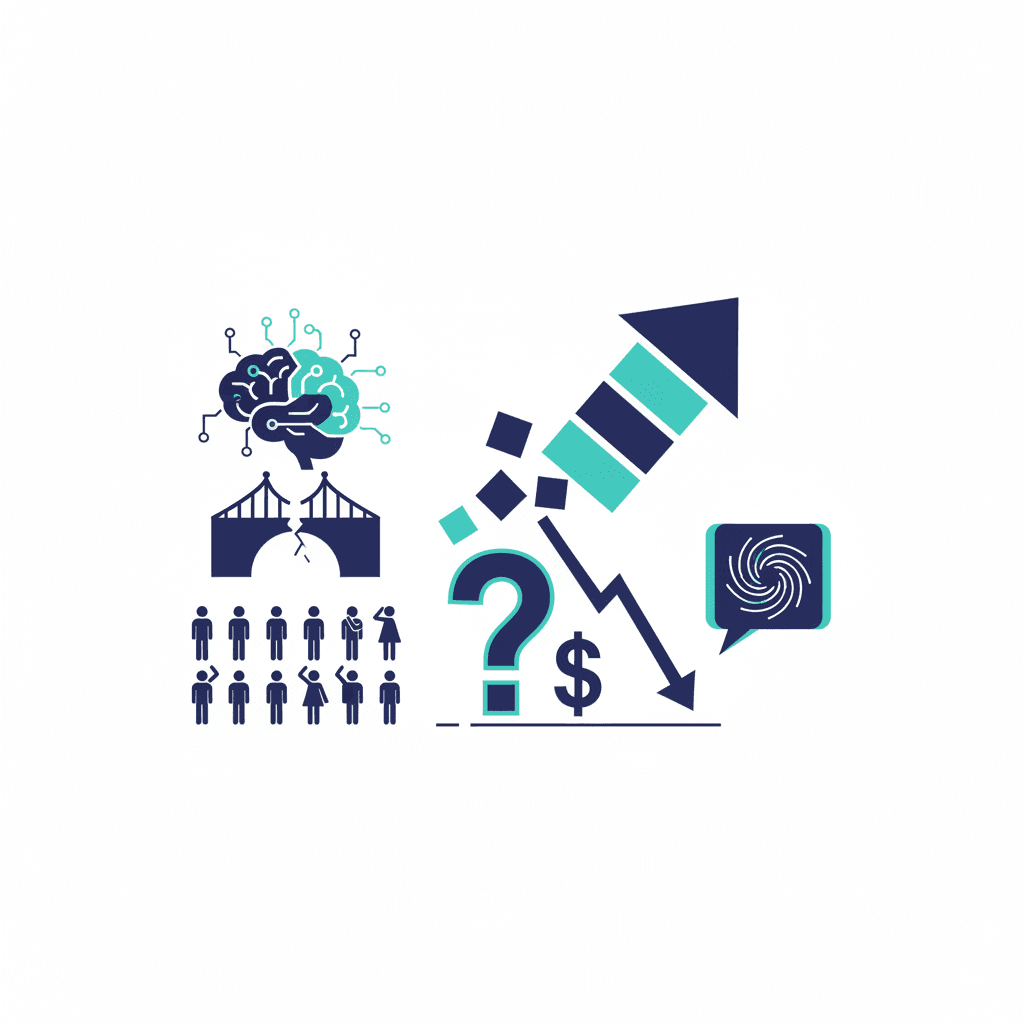
Forty thousand dollars and five months later, they had a custom tool that could summarize research papers, generate first-draft report sections, and pull competitor data from public sources. The tool worked exactly as specified.
Nobody used it.
What went wrong
The brief — "make our research faster and deliverables better" — sounds specific. It isn't. It describes a desired outcome without defining a problem.
The consulting firm didn't ask the obvious follow-up question: which specific step in your research process takes the most time, produces the most errors, or creates the most frustration? They built a tool to match the brief. The brief was wrong.
What the firm's consultants actually struggled with was a specific, narrow problem: extracting consistent, comparable data from client financial documents to populate the analysis frameworks they used in every engagement. This took 4 to 6 hours per engagement, was error-prone, and was genuinely well-suited to AI automation.
Nobody identified this problem before the project started because nobody mapped the workflow carefully enough. The firm bought a general-purpose research tool when they needed a specific-purpose data extraction tool. The technology would have been the same; the problem definition was different.
The $5,000 question that would have prevented it
Before any project scope is agreed and before any money changes hands, there is one question worth spending serious time on: "What is the single most painful, repetitive, time-consuming step in our workflow, and what does doing it poorly cost us?"
Not "how could AI help us generally." That question leads to general answers and general tools. The specific question leads to a specific problem and a specific build.
For this Chicago firm, answering that question carefully would have taken maybe two hours. It would have produced a scope for a tool that extracts and normalizes financial data from client documents — a project worth roughly $15,000, with a clear ROI calculation of 5 hours saved per engagement at $200/hour billed time.
Instead they spent $40,000 on a tool that nobody was specific enough about to need.
Reality check: a well-scoped AI build doesn't need five figures. We put a live AI chatbot demo online — lead follow-up, website Q&A, employee helpdesk — the kind of tightly scoped build that starts around $500 and ships in 1–2 weeks. Try it before you scope anything.
What they did next
Six months after the failed project, they hired a different firm for a tightly scoped engagement: automate the financial data extraction step. Three weeks. $12,000. Every consultant now uses it on every engagement. The time saving is 4 hours per project. At their volume, that's recovered the cost within 60 days.
The lesson isn't that AI consulting firms are predatory or that AI projects always fail. It's that the most expensive part of any AI project is the decision made in the first conversation — and that decision should be: "What specific problem, with measurable impact, are we solving?"
If you can't answer that in one clear sentence, the project is not ready to start. See Questions to Ask Before Hiring an AI Consultant for how to vet the person you're about to have that conversation with. This kind of expensive lesson is common — see 47% of US Small Businesses Use AI: What Are the Rest Waiting For?. And most of it is preventable on the client's side — see How to Prepare for a Consulting Engagement. If you'd rather feel the difference than read about it, play with our live chatbot demo — that's what a tightly scoped build looks like. You can even tour the owner's dashboard such a build ships with.
Frequently asked questions
What percentage of AI projects fail to deliver measurable value?
Estimates range from 70% to 85% of AI initiatives failing to reach production or deliver expected ROI, according to multiple analyst surveys. The most common single cause: the project started without a specific, measurable business problem to solve.
How do you define a good AI project scope?
A good scope has three things: a specific, measurable problem (not 'improve efficiency' but 'reduce proposal drafting time from 4 hours to 45 minutes'), a defined success metric, and a clear escalation path if the AI can't handle an input. Any scope missing one of these three is too vague to deliver reliably.
What should a US business expect to pay for a proof-of-concept AI project?
A well-scoped AI proof of concept — defining the problem, testing feasibility, and delivering a working prototype — should cost $5,000 to $20,000. This is separate from full implementation. Never commit to a full implementation budget without a POC that proves the approach works on your actual data.
How do I know if an AI vendor is overselling their capabilities?
Ask them to demo on your data, not their demo data. Ask to speak with two clients whose problems were similar to yours. Ask what happens when the AI encounters an input it can't handle confidently. Vendors who answer these questions directly are credible. Vendors who redirect to capability demos are not.
Yash
Founder & Principal Consultant, Ynexgen
Yash leads Ynexgen, helping small and mid-sized businesses turn technology into a stronger foundation for growth — 7+ years across Salesforce CRM, websites, and AI adoption.