"Our CRM doesn't work for us."
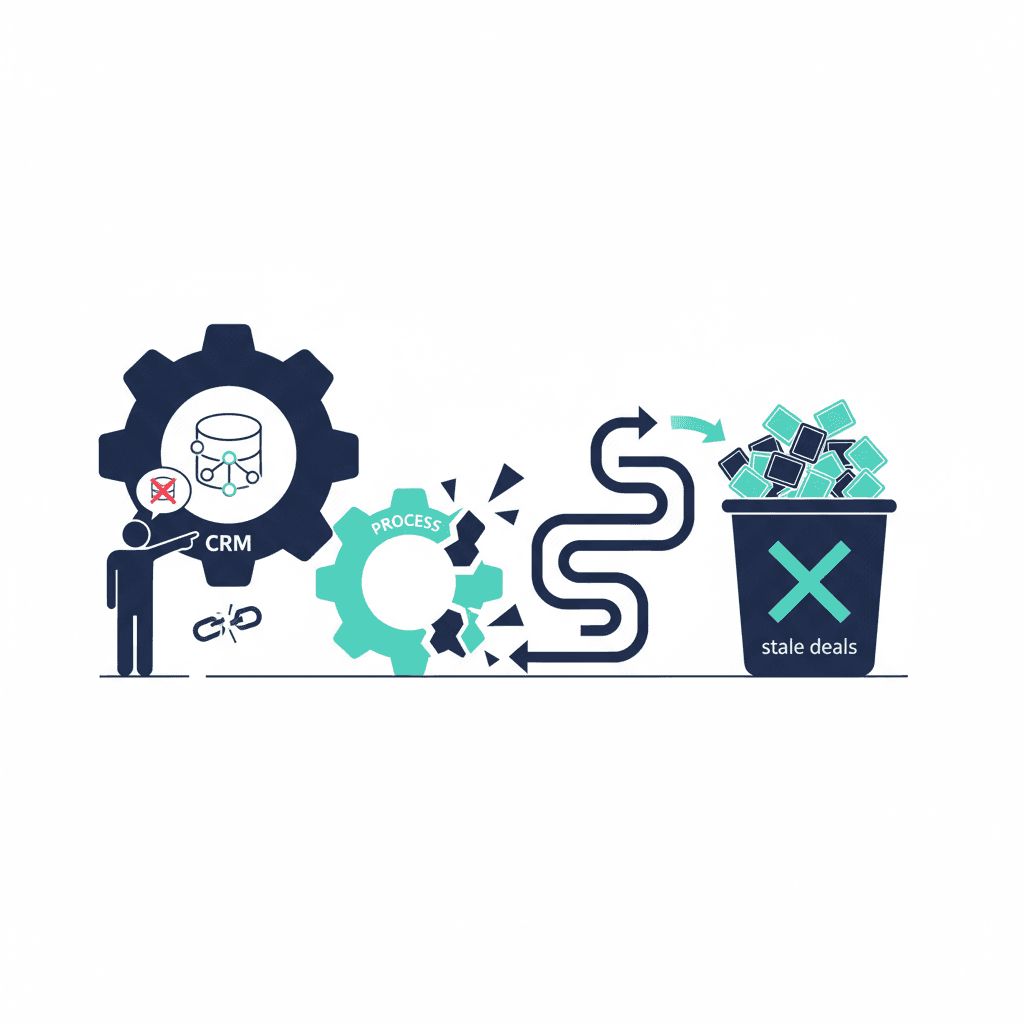
I've heard this sentence many times. In almost every case, what the person means is: our sales team doesn't use the CRM consistently, our pipeline data isn't reliable, and we're not getting the reporting visibility we expected.
None of those things are caused by the CRM.
A CRM doesn't decide to skip logging a call. It doesn't choose to move a deal to the wrong stage. It doesn't create duplicate contact records out of boredom. People do those things — or don't do them — for reasons that exist independently of the software.
What actually causes CRM failure
When a CRM implementation fails, the root cause is almost always one of three things.
The business didn't have a defined sales process before implementing the CRM. The CRM was expected to create one. It can't. A CRM enforces and makes visible the process you give it. If the process is "call prospects until some of them buy," the CRM can track that — it cannot transform it into something more systematic.
Nobody made the CRM the authoritative source of pipeline truth. If managers run their weekly calls from whatever the salesperson says verbally, the CRM is for the admin team's reporting, not for actual decision-making. People update things that affect decisions. They don't update things that don't.
The person who bought the CRM and the people who use it daily have different problems. The buyer wanted pipeline visibility. The salesperson wants to spend time selling. These aren't incompatible — but if the CRM only solves the buyer's problem without solving the user's problem, usage will be perfunctory.
The uncomfortable truth about switching CRMs
A significant portion of businesses that are unhappy with Salesforce switch to HubSpot. A significant portion that are unhappy with HubSpot switch to Pipedrive. Some proportion of those switch back to Salesforce.
The outcomes after switching are mixed because the tool wasn't the variable. The process — the discipline of using a CRM consistently, the management behaviour that reinforces it, the decisions about what gets tracked — was the variable. It moved with them.
Before switching CRMs, or before implementing a new one, the questions worth answering are: what behaviour are we expecting to change, specifically? What management action will enforce that change? What does the tool need to do to make compliance easier than non-compliance?
Answer those questions clearly and the choice of CRM matters much less than the marketing suggests. If the tool itself really is the mismatch, see our industry-specific breakdowns for professional services, e-commerce, and real estate. If the number you were promised hasn't shown up, see The CRM ROI Number You've Been Quoted Is Wrong.
Frequently asked questions
How do I know if my CRM problem is really a process problem?
Ask: did the problem exist before you got the CRM? If deals were falling through cracks before Salesforce, they'll fall through after. If follow-up was inconsistent before HubSpot, it'll be inconsistent after. The CRM makes existing problems more visible — it doesn't create them and can't eliminate them without process work.
Should I fix my process before implementing a CRM?
You need to fix your process alongside implementing the CRM, not necessarily before. The CRM implementation process itself — defining pipeline stages, setting data standards, establishing review cadences — is a forcing function for process improvement. But if you go live without those decisions made, the CRM won't do the work for you.
Is there a minimum process maturity needed before CRM adds value?
Yes. At minimum: someone owns each active deal, there are defined stages a deal passes through, and there's a regular cadence (weekly at minimum) where pipeline is reviewed by a manager. Without these three things, a CRM is an expensive contact list.
Can the CRM help improve process, or does process have to come first?
Both. A CRM makes process gaps visible in a way that's hard to ignore — when the pipeline report shows 40% of deals haven't been touched in three weeks, that's a prompt for a conversation that might not have happened otherwise. Use the CRM's reporting to diagnose process gaps, then address them.
Yash
Founder & Principal Consultant, Ynexgen
Yash leads Ynexgen, helping small and mid-sized businesses turn technology into a stronger foundation for growth — 7+ years across Salesforce CRM, websites, and AI adoption.