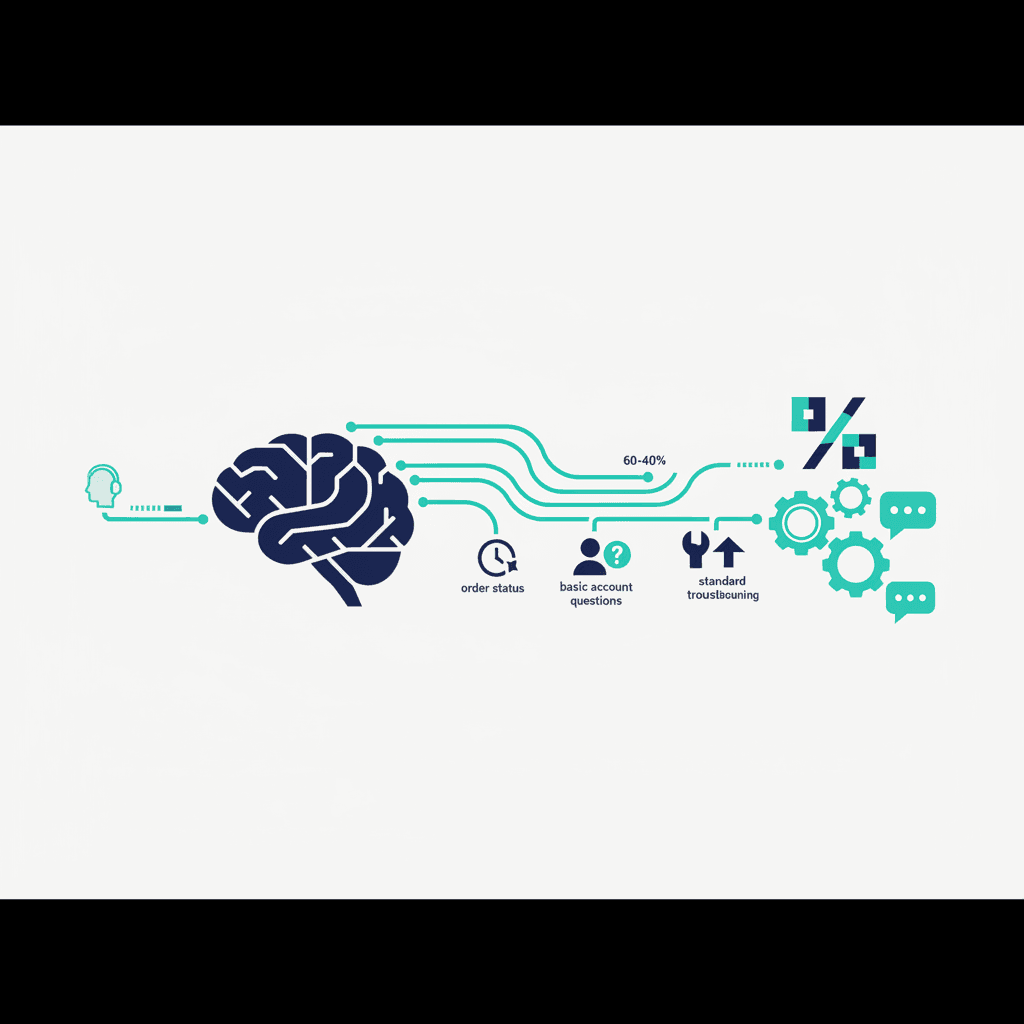
Order status. Basic account questions. Standard troubleshooting steps. Across most support teams, this small set of 20 to 30 question types accounts for 60 to 70% of total support volume — and almost none of it requires human judgment to answer well. (For what a support bot costs to build, see AI chatbot cost.)
This is one of six tasks we consistently see deliver real ROI when automated — see the full list in 6 Business Tasks Worth Automating with AI in 2026.
Why tier-one queries are the right place to start
Support automation gets a bad reputation from bots that try to handle everything, including the genuinely hard, emotionally loaded, or unusual cases — and fail badly at all three. Tier-one automation avoids this by design: it only handles the narrow, well-defined, high-frequency questions where the answer is the same every time, and routes everything else to a person immediately.
What the automation actually does
A well-scoped setup identifies your top 20 to 30 recurring question types (this list comes directly from your existing support ticket history — don't guess), builds accurate automated answers for each, and — critically — detects when a query doesn't match one of those types and hands off to a human without making the customer repeat themselves.
How to actually build the question list
Pull your last 200-300 support tickets and categorize them by topic, not by exact wording — "where's my order" and "when will my package arrive" are the same question type. In most businesses, this exercise surfaces the same handful of categories dominating volume: order/shipping status, basic account changes (password reset, billing address), and a short list of the most common product or service questions. Rank these by frequency and start automating from the top down — automating your #1 most common question type alone often clears 15-20% of total volume.
What good looks like
Customers with a simple question get an instant, accurate answer at any hour, without waiting in a queue behind someone with a genuinely complex problem. Your support team spends their time on the 30-40% of volume that actually needs a person, instead of splitting attention across everything. Handoffs to humans include the full conversation context — no "please explain your issue again."
Measuring whether it's actually working
Track three numbers after launch: the percentage of inbound queries the automation resolves without escalation (a healthy setup lands 50-70% here for well-chosen question types), customer satisfaction on automated resolutions specifically (should be close to human-handled satisfaction, not noticeably worse), and average time-to-resolution for escalated queries (should improve, since your team isn't splitting attention across easy and hard cases anymore).
The most common mistake
Trying to make the bot look human and hoping it can improvise outside its trained scope. Customers tolerate an obviously automated system that's fast and accurate far better than a system pretending to be human that gives a wrong or evasive answer. Be upfront that it's automated, keep its scope narrow, and make the escalation path to a real person obvious and immediate.
Done this way, tier-one automation doesn't reduce your support quality — it protects your team's attention for the interactions where a human actually changes the outcome.
Frequently asked questions
Will customers get frustrated talking to a bot?
Less than you'd expect, as long as it's fast, accurate within its scope, and hands off to a human immediately when a question falls outside that scope — the frustration comes from bots that pretend to help and fail, not from bots that are clearly automated and succeed.
How do I know which 20-30 questions to automate first?
Pull your support ticket history and sort by frequency — the top 20-30 categories almost always account for the 60-70% figure. Don't guess; the actual distribution is usually more concentrated than people expect.
What happens to queries the AI doesn't recognize?
They should route to a human automatically, with the full conversation so far included — the goal is a seamless handoff, not a dead end.
Yash
Founder & Principal Consultant, Ynexgen
Yash leads Ynexgen, helping small and mid-sized businesses turn technology into a stronger foundation for growth — 7+ years across Salesforce CRM, websites, and AI adoption.