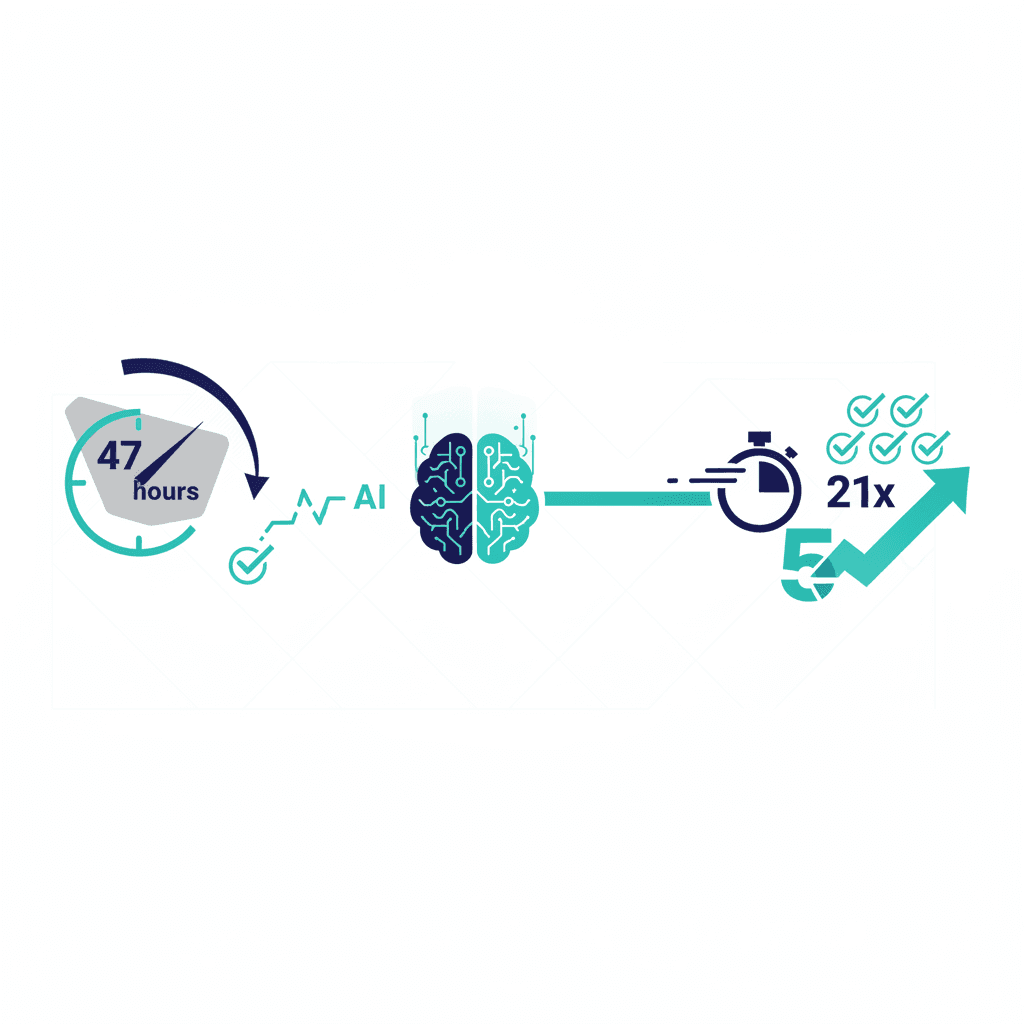
The average business takes 47 hours to respond to a new inbound lead. Companies that respond within 5 minutes are 21 times more likely to qualify that lead than companies that wait even 30 minutes. This is one of the widest gaps between "what's possible" and "what most businesses actually do" in the entire sales process — and it's also the single highest-ROI place to apply AI automation for a service business.
This is one of six tasks we consistently see deliver real ROI when automated — see the full list in 6 Business Tasks Worth Automating with AI in 2026.
Why the gap is this large
Lead interest decays fast. Someone who fills out a form on your website is comparing you to two or three competitors at that exact moment. Whoever responds first — with something more useful than "thanks, we'll be in touch" — usually wins the conversation, and often the deal, before a human on your team has even seen the notification.
The 47-hour average isn't because businesses don't care. It's because lead response depends on a specific person checking a specific inbox at a specific time, and that person is usually busy doing something else — the actual client work that pays the bills.
What the automation actually does
A well-built lead response system does three things within about 2 minutes of a form submission:
- Sends a personalised response — not a generic autoresponder, but something referencing what the lead actually asked about, pulled from the form fields or the page they were on.
- Asks 2 to 3 qualification questions — budget range, timeline, specific need — conversationally, not as a wall of dropdowns.
- Routes based on the answers — a high-intent, well-budgeted lead goes straight to a calendar link or a human; a low-fit lead gets a helpful resource instead of a sales pitch.
None of this requires a custom-built AI model. It's a workflow tool (something like a chatbot builder or automation platform) connected to your CRM and calendar, with an AI model handling the natural-language part of the conversation.
What "good" looks like
The bar isn't "fully automates the sale." It's "closes the gap between form submission and first meaningful contact." A good setup gets a real response in front of the lead within 2 to 5 minutes, asks enough to know whether this is worth a human's time, and hands off cleanly when it is. The human still closes the deal — the automation just makes sure the lead is still warm when they get there.
The most common mistake
Treating the automated response as the whole system, instead of the front door to a human handoff. If a qualified, ready-to-buy lead answers all three questions and then sits in a queue for two days because no one reviews the routing, you've automated the easy part and left the actual bottleneck untouched. Build the handoff step with the same care as the response step.
Businesses that get this right don't need more leads. They need to stop losing the ones they already have to slow response times — and this is the cheapest, fastest fix available. For a broader, more skeptical look at what AI can and can't reliably do across the rest of the sales process, see AI Sales Automation: What Actually Works. The same principle applies to the follow-ups after that first response — see Automate Customer Follow-Up with AI.
Frequently asked questions
How fast does a lead response actually need to be?
Under 5 minutes is the benchmark that produces the 21x qualification lift cited in sales-response research. Beyond about 30 minutes, the advantage drops off sharply as the lead moves on to other options.
Do I need a custom AI model to build this?
No. This is an integration project — connecting an existing chatbot/automation platform (which uses an off-the-shelf language model) to your CRM and calendar — not a custom model-training project.
What if the AI's qualification questions get it wrong?
Build a manual review step for edge cases and check routing accuracy weekly for the first month. Most errors come from ambiguous form answers, not the AI itself, and are easy to catch early.
Yash
Founder & Principal Consultant, Ynexgen
Yash leads Ynexgen, helping small and mid-sized businesses turn technology into a stronger foundation for growth — 7+ years across Salesforce CRM, websites, and AI adoption.