Professional services firms — law, accounting, consulting — don't sell the way a typical CRM assumes. There's no simple lead-to-close pipeline; there's referrals, long relationships, and repeat engagements over years. Configuring a CRM around a standard sales pipeline for this kind of business misses what actually drives its growth.
What's structurally different about professional services
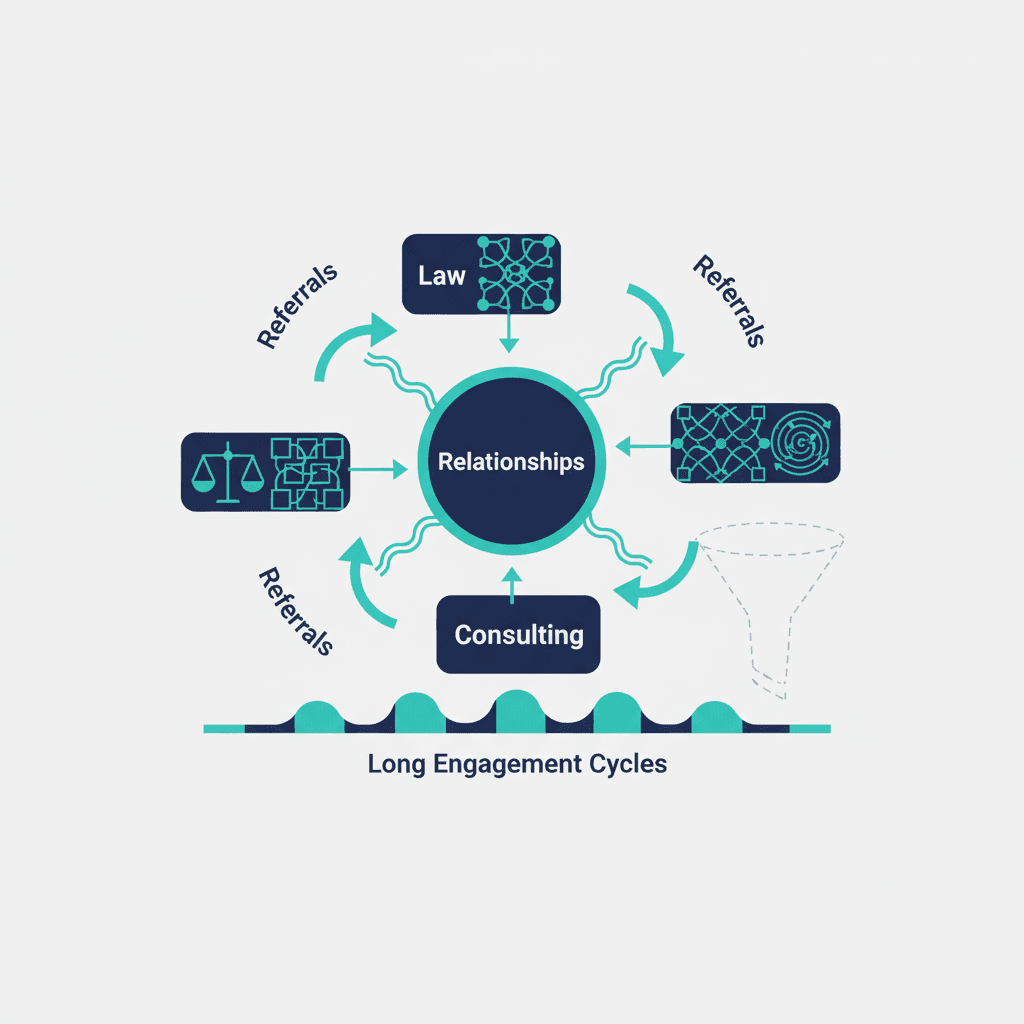
Referrals, not cold leads, drive most new business. A generic CRM's lead-source field is usually an afterthought. For professional services, referral tracking should be central: who introduced this client, which referral sources are actually productive, and who deserves a thank-you or reciprocal introduction. If your CRM can't answer "which of our referral partners actually sends us paying clients" in a few clicks, it's not tracking what matters most.
Relationships persist past a single "deal." A law firm's client from three years ago who returns for a new matter isn't a "new lead" — they're a returning relationship with history that should be immediately visible. A CRM that treats every new engagement as a fresh, disconnected deal loses the context that makes the second (and third, and tenth) engagement faster and better.
The sales cycle is really a trust cycle. Professional services buying decisions run on reputation and personal trust more than most other categories. Tracking touchpoints — a conference conversation, a shared article, a casual check-in call — matters more here than it would in a transactional sales pipeline, because those touchpoints are what convert a contact into a client eighteen months later.
What to actually configure
- A referral-source field that's mandatory and reportable, not optional and ignored
- Client history that spans multiple engagements/matters, not one deal per client record
- A "dormant relationship" view — clients you haven't touched in 6+ months who are worth a check-in
- Simple, low-friction activity logging — professional services staff are billing hours, not filling out CRM fields, so anything that takes more than a few seconds per entry won't get used
The most common mistake
Buying an enterprise CRM built around a sales team's pipeline stages and forcing partners/consultants to use it the same way. Partners aren't SDRs; they won't fill out 12 pipeline-stage fields for a relationship they've had for a decade. Configure for how the business actually works, or accept that adoption will be low regardless of the tool's capability.
The honest recommendation
Whatever CRM you choose, spend real configuration time on referral tracking and relationship history before worrying about pipeline stages — those two things reflect how professional services actually grows — see What Is CRM and Why Every Small Business Needs One for the fundamentals. If you're evaluating options, see our Salesforce CRM consulting for help configuring around your actual referral and engagement model rather than a generic sales template. Law firms specifically weighing a CRM alongside a website refresh may also want our law firm website pricing guide.
Frequently asked questions
Why doesn't a standard sales-pipeline CRM setup work for professional services?
Because most professional services revenue comes from referrals and existing relationships, not a linear lead-to-close pipeline — a CRM configured around cold-lead stages misses the actual structure of how the business gets work.
What should a professional services CRM track instead?
Referral sources and who introduced whom, full engagement/matter history per client (not just a single "deal"), and relationship touchpoints over time — repeat engagements and referrals are the real growth engine, and the CRM should make both visible.
Is Salesforce overkill for a small professional services firm?
Often, yes — its default setup assumes a transactional sales pipeline. A firm can configure Salesforce to fit, but a CRM with simpler relationship/referral-first defaults (or a well-configured lighter tool) often gets there faster.
Yash
Founder & Principal Consultant, Ynexgen
Yash leads Ynexgen, helping small and mid-sized businesses turn technology into a stronger foundation for growth — 7+ years across Salesforce CRM, websites, and AI adoption.