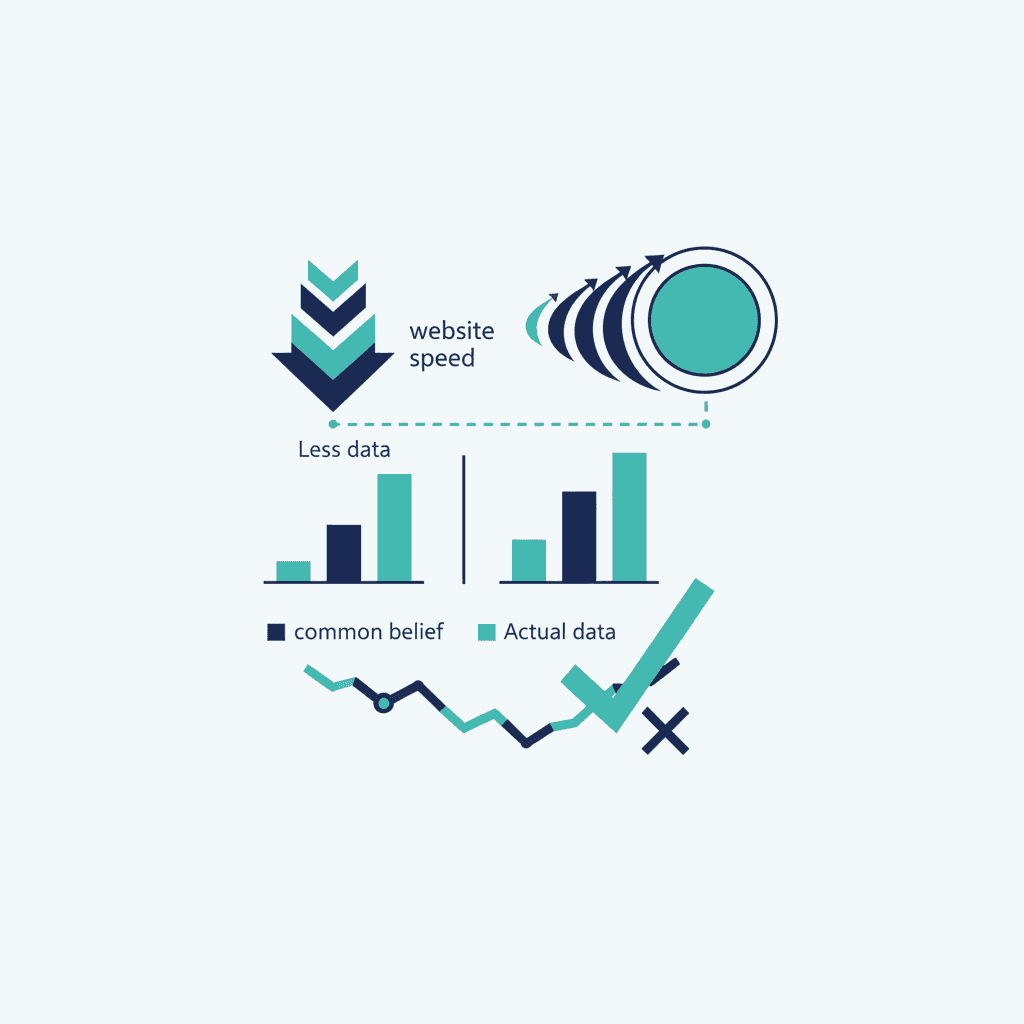
"Faster websites convert better" gets repeated constantly in web development marketing, often with a specific statistic attached that doesn't hold up well to scrutiny once you ask where it came from. The underlying relationship is real — but it's worth being precise about what the data actually supports.
What's well-supported
Slow-loading pages lose visitors before those visitors ever see the content — this part is well documented and intuitive: someone waiting five seconds for a page to load has time to hit back and try a competitor before your page even finishes rendering. This is a threshold effect, not a smooth curve — visitors who'd wait 3 seconds might abandon entirely at 6, rather than converting at a proportionally lower rate.
Largest Contentful Paint (LCP) — see our dedicated explainer — is the metric most directly tied to this abandonment behavior, since it measures when the main content actually becomes visible, which is the moment a frustrated visitor either sticks around or leaves. (The other two Core Web Vitals, CLS and INP, matter too, though less directly for this specific abandonment pattern.)
What's often overstated
The specific percentage figures circulated in marketing content (commonly some version of "every second costs you X% of conversions") typically trace back to a small number of specific large e-commerce case studies, not a universal law that applies identically to every website, industry, and audience. A B2B consulting site's visitors and a high-volume e-commerce store's visitors don't necessarily behave identically under the same load-time pressure. Treat cited percentages as directional evidence that speed matters, not as a number you can plug into your own revenue forecast.
Why speed is a threshold, not a differentiator
A site that loads in 1.5 seconds doesn't meaningfully outconvert one that loads in 2.5 seconds if both are comfortably under the point where visitors get impatient — speed matters most for getting under the abandonment threshold, not for continuously optimizing further once you're already fast enough. Beyond that point, design, content quality, and offer clarity matter more for the actual conversion decision.
What to actually do
Get your LCP under Google's "good" threshold (2.5 seconds) — this is the piece with real, well-supported downside if you don't. Beyond that threshold, further speed optimization has diminishing returns compared to improving the actual content and design that determines whether a visitor who did wait for your page converts once they see it.
The most common mistake
Obsessing over shaving fractions of a second off an already-fast site while ignoring a genuinely slow-loading page elsewhere on the same domain. Fix the worst offenders first — a single slow page (often a heavy product page or an unoptimized image-heavy landing page) can undermine an otherwise solid site's overall performance data.
The honest recommendation
Treat speed as a pass/fail threshold to clear (under 2.5 seconds LCP), not an infinite optimization target. Once you've cleared it, redirect effort toward content and design — that's where additional conversion gains are actually available.
Frequently asked questions
How much does a 1-second delay actually cost in conversions?
Industry-cited figures (commonly around a 7% conversion drop per second of added load time) come from specific large e-commerce studies and don't transfer precisely to every business — the direction (slower hurts conversions) is well supported; the exact percentage varies by site and audience.
Which speed metric matters most for conversions?
Largest Contentful Paint (LCP) — how fast the main visible content appears — correlates most directly with whether a visitor sticks around, since it's the point where a slow-loading page visibly frustrates someone before they've seen anything worth staying for.
Is site speed more important than design or content?
No — speed is a threshold factor, not a differentiator. A fast site with weak content or design won't outperform a well-designed, fast-enough site; but a slow site loses visitors before design or content ever gets evaluated.
Yash
Founder & Principal Consultant, Ynexgen
Yash leads Ynexgen, helping small and mid-sized businesses turn technology into a stronger foundation for growth — 7+ years across Salesforce CRM, websites, and AI adoption.