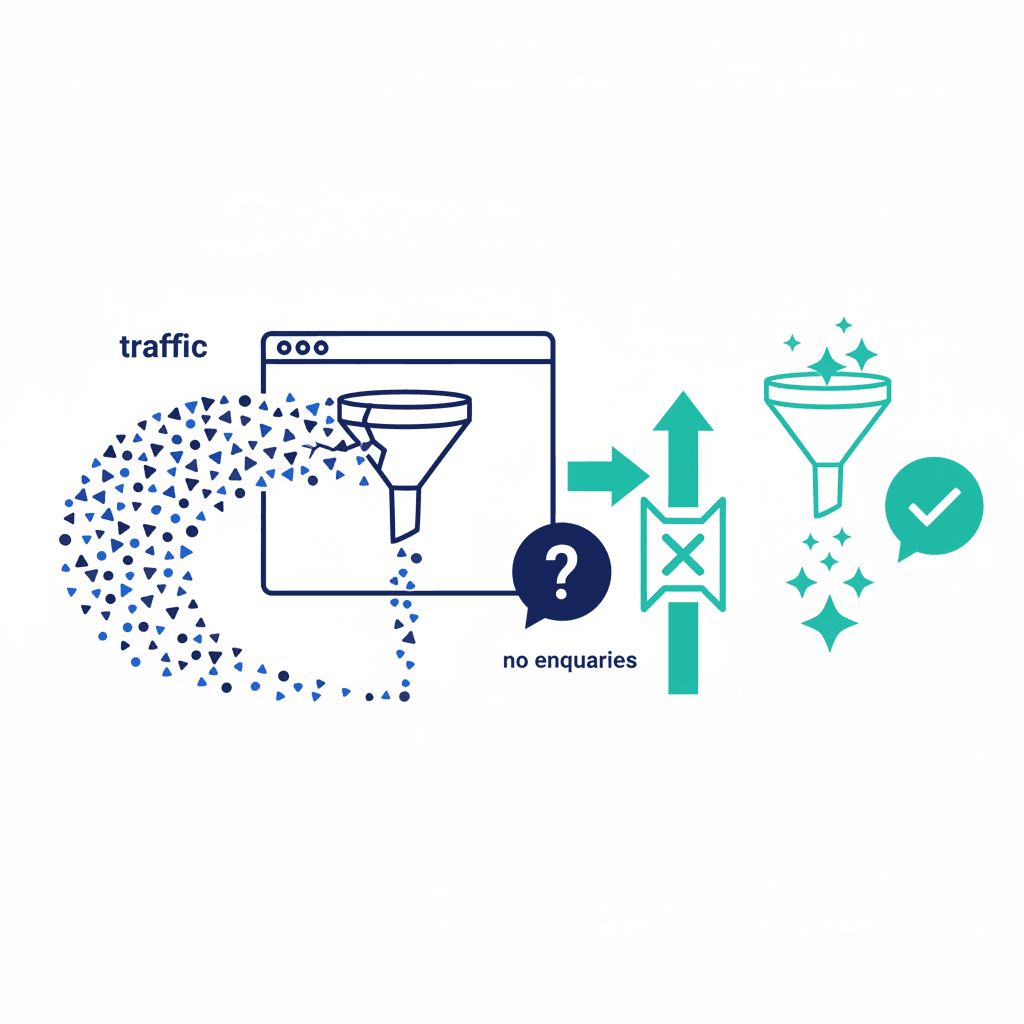
Traffic is the wrong metric to optimise first.
If a hundred people visit your website every day and zero of them enquire, getting two hundred visitors will get you approximately zero enquiries. Conversion is a design and messaging problem. Throwing more traffic at a broken funnel doesn't fix the funnel.
Here's where the problem usually lives.
The call to action is unclear, buried, or missing
The most common conversion problem is that visitors don't know what to do next. They read your services page, they're interested, and then they arrive at the bottom of the page and there's... nothing. Or there's a "Contact Us" link in the navigation that they might or might not click.
Every page that can generate an enquiry needs a specific call to action in a prominent position: "Book a free 30-minute consultation," "Get a quote," "Ask us a question." The button should be above the fold on desktop and visible without scrolling on mobile.
If your CTA is in the footer, it will not convert.
Your messaging describes what you do, not what you solve
There's a significant difference between "We provide Salesforce CRM implementation services for small and mid-sized businesses" and "We help your sales team stop losing deals in spreadsheets."
The first describes a service. The second describes a result. Visitors land on your website with a problem, not a solution in mind. If your homepage leads with the solution before they've been shown you understand the problem, they don't connect with it.
Lead with the problem. Follow with how you solve it. Then establish credibility. Then ask them to act.
There's no social proof
Trust is the barrier between reading your website and filling in the form. A visitor who doesn't know you is being asked to hand over their email address, phone number, and details about their business to a stranger.
Testimonials, case studies, client logos, and specific results (not vague superlatives) collapse that trust barrier. "We helped a 12-person consulting firm increase qualified lead volume by 40% in three months" is infinitely more persuasive than "We're passionate about helping businesses grow."
Specific, real, attributable proof converts. Generic claims don't.
Your contact form asks too much
A form with eight fields does not convert as well as a form with three. Every additional field reduces completions. The goal of a contact form is to get a name, an email, and enough information to send a useful reply. That's it.
Name. Email. One open question: "What can we help you with?" That form converts. A form that also asks for company name, phone number, budget range, timeline, and how they heard about you does not — even if you need that information eventually, you don't need it from the form.
The mobile experience is broken
If 60% of your visitors are on mobile and your form requires desktop-level typing, your service page requires horizontal scrolling, or your CTA button is 12 pixels tall, you're not getting mobile conversions. Check your site on your phone. Submit the form yourself. If anything feels like friction, it's costing you leads.
The fix is almost never a new website. It's targeted changes to the pages that receive the most traffic — better copy, stronger proof, clearer CTA, simpler form. Most businesses that implement these four changes see meaningful enquiry increases within 60 days. If traffic used to convert and suddenly stopped, see Great Traffic, Zero Enquiries: What Changed? for a different diagnosis. Left unfixed long enough, this is exactly The Business Losing Deals Nobody Knew About.
Frequently asked questions
What is a good website conversion rate for a service business?
For a service business, converting 2% to 5% of visitors into leads is typical. Above 5% is strong. If you're below 1%, there's a fundamental problem with your messaging, trust signals, or call to action — not your traffic source.
Should I use a pop-up to capture leads?
Exit-intent pop-ups with a genuine offer (a free consultation, a useful checklist) can increase lead capture by 10 to 20% without significantly disrupting the user experience. Aggressive pop-ups that appear immediately or block content hurt conversions and increase bounce rates.
How do I know which page is causing the drop-off?
Install Google Analytics and look at your page-level bounce rates and exit rates. The page with the highest exit rate for your most valuable traffic is where your conversion problem lives. Fix that page first.
Does adding more content to a service page help conversions?
It depends on what the content does. Content that addresses objections, provides proof, and clarifies what happens after enquiry improves conversions. Content that buries the call to action under too much information hurts them. Longer isn't always better — more persuasive is.
Yash
Founder & Principal Consultant, Ynexgen
Yash leads Ynexgen, helping small and mid-sized businesses turn technology into a stronger foundation for growth — 7+ years across Salesforce CRM, websites, and AI adoption.