The word "agent" is doing a lot of work in technology marketing right now. It's been attached to everything from simple auto-replies to genuinely sophisticated systems that can run entire workflows independently.
Here's what it actually means.
The simplest definition
An AI agent is software that can perceive its environment, reason about what to do, and take actions to accomplish a goal — without a human directing each step.
That's the meaningful distinction from a regular AI chatbot, which can generate text but can't do anything with it. Here's the difference made concrete:
A customer emails your support team: "My order hasn't arrived and I'm leaving for a trip tomorrow morning." A chatbot reads that and sends back "We're sorry to hear about your experience. A team member will be in touch shortly." An AI agent reads it, checks the order status in your system, sees it shipped but the tracking shows a delay, generates a personalised response with the new estimated delivery date and a direct link to contact the carrier — and flags the ticket for human review because the customer mentioned time pressure. Same email. Completely different outcome.
That's what agents do. They don't just respond — they act, and they use context to decide what action is appropriate.
(For where agents fit into everyday operations, see business tasks worth automating with AI.)
How agents actually work
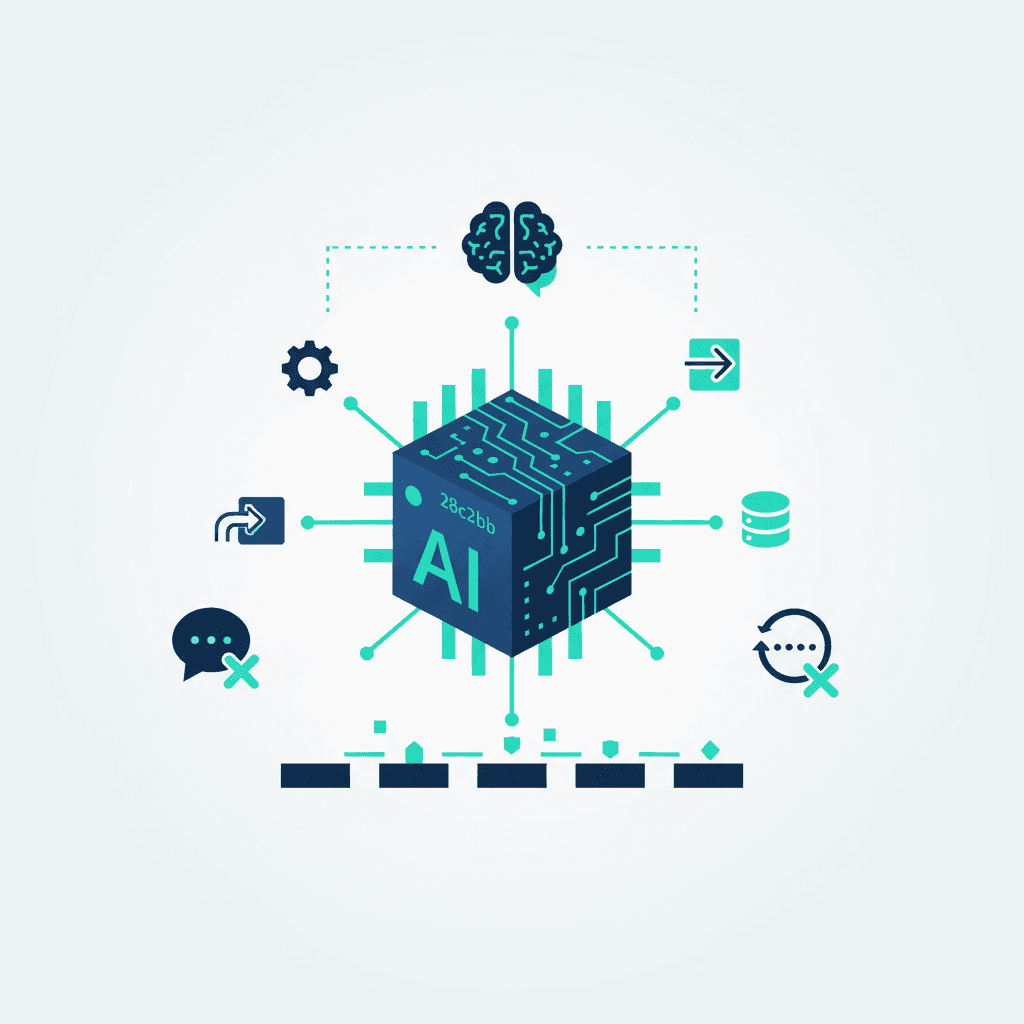
Most agents are built on top of a large language model (ChatGPT, Claude, or similar) combined with tools that let the model take actions. The model reads the situation, reasons about what to do, and then calls one of those tools — "check the inventory system," "send an email," "update this database record."
What makes this different from the AI you've used before is the feedback loop. The agent can see the result of its action, reason about whether it worked, and decide what to do next. It's iterating through a problem, not just responding to a single prompt.
What agents are genuinely good at
The strongest use cases share three characteristics: the task is repetitive, the decision rules are definable, and the data is structured.
Customer service tier-one queries fit this perfectly. The same 20 to 30 question types typically account for 60 to 70% of support volume. An agent can handle them all day, every day, without fatigue or inconsistency.
CRM data hygiene is another strong fit. Most businesses have CRMs full of outdated records, missing fields, and duplicate contacts. An agent can audit records overnight, flag anomalies, and queue up corrections for human review — work that would take a person weeks.
Lead qualification is increasingly common: an agent that engages incoming leads with a defined set of discovery questions, scores them against your criteria, and routes qualified leads to a human rep while sending non-qualified leads into a nurture sequence.
What agents aren't good at
Tasks that require genuine judgement, empathy, or contextual nuance. An agent can handle "where is my order" but not "I'm really frustrated and thinking about cancelling my subscription" — at least not without a human in the loop.
Novel situations. Agents handle defined workflows well. Anything outside the expected range of inputs will produce unpredictable results. This is why the escalation path isn't optional.
Unstructured or dirty data. An agent is only as reliable as the data it reads. If your CRM has inconsistent formats, missing fields, and outdated records, the agent will surface that inaccuracy to customers.
Where to start
The best first agent is the smallest possible one. Automate one task that your team does manually more than ten times a week, has clear decision rules, and doesn't require complex judgement. For most service businesses, that's follow-up emails. For retail, order status queries. For professional services, meeting scheduling.
Build it small. Watch it work. Then expand. If you're specifically evaluating Salesforce's own agent product, see What Is Salesforce Agentforce?.
Frequently asked questions
What's the difference between an AI agent and a chatbot?
A chatbot responds to questions using pre-written answers or simple pattern matching. An AI agent can reason through a problem, take actions (book a meeting, update a record, send an email), and handle multi-step tasks without a human directing each step.
Do I need to be technical to use an AI agent?
For off-the-shelf agents (customer service bots, scheduling assistants), no. For custom agents built to your specific workflow, you need either a developer or a no-code background. Tools like n8n, Make, and Zapier have made basic agents accessible to non-technical teams at low cost.
How much does it cost to build an AI agent for my business?
Simple agents using no-code tools cost $500 to $5,000 to build and $100 to $500 per month to run. Custom agents requiring development work cost $15,000 to $60,000 to build. The underlying AI costs (API calls to OpenAI or Anthropic) are typically $50 to $500 per month depending on volume.
What happens when an AI agent makes a mistake?
Well-designed agents have human escalation built in — when confidence is low or the situation is ambiguous, they pause and route to a human. The mistakes happen when agents are deployed without guardrails. Always build in an escalation path and review AI outputs for the first 4 to 6 weeks before trusting them fully.
Yash
Founder & Principal Consultant, Ynexgen
Yash leads Ynexgen, helping small and mid-sized businesses turn technology into a stronger foundation for growth — 7+ years across Salesforce CRM, websites, and AI adoption.