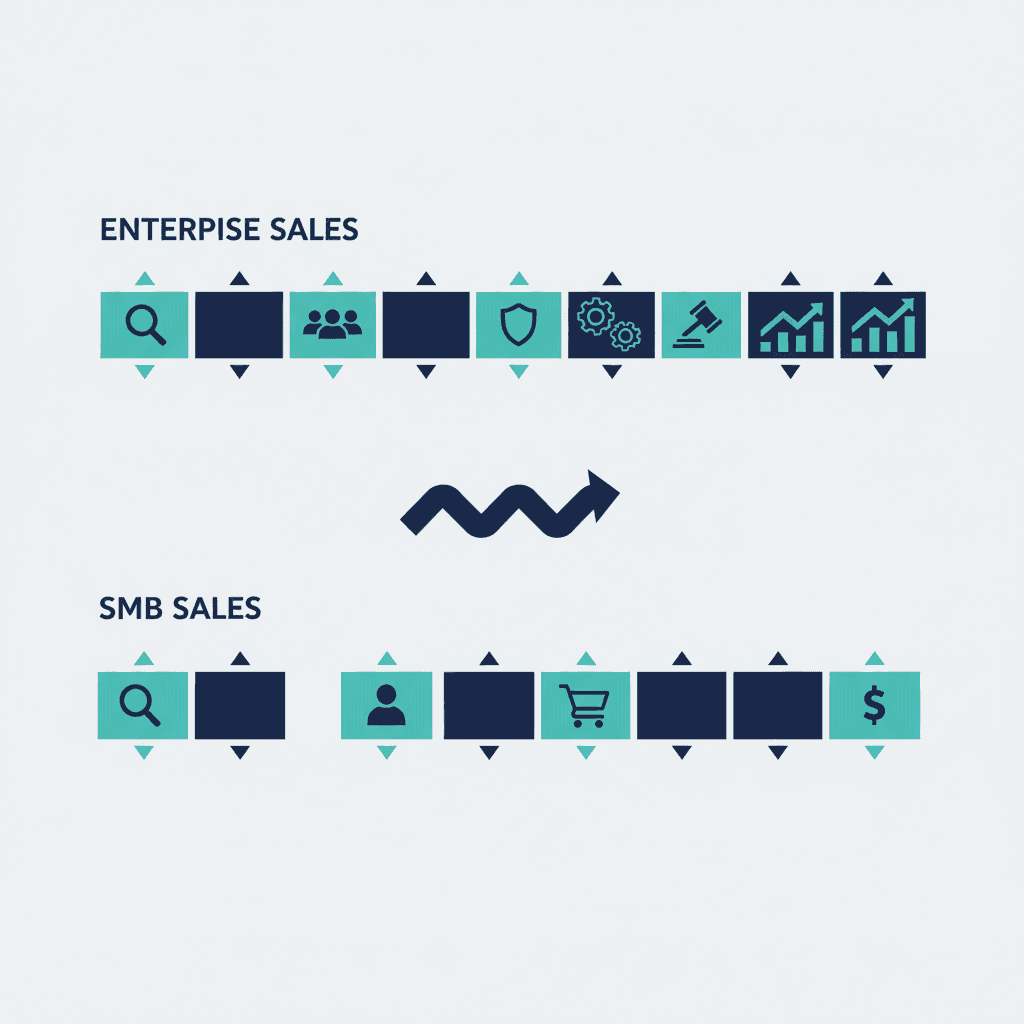
Enterprise sales pipelines have more stages than small-business ones — typically 7 to 9 — because the deals are larger, the buying committees bigger, and steps like security review, procurement and legal are genuine stages rather than afterthoughts. Here's a typical enterprise pipeline and how it differs from an SMB one.
A typical enterprise pipeline
| Stage | What it involves |
|---|---|
| Prospecting | Account research, multi-threading into the org |
| Discovery | Mapping needs across a buying committee |
| Solution / Demo | Tailored demonstration to stakeholders |
| Business case / ROI | Justifying spend to economic buyer |
| Technical / Security review | InfoSec, integration, compliance validation |
| Procurement | Vendor onboarding, pricing negotiation |
| Legal / Contract | Redlines, MSA, terms |
| Closed Won / Lost | Signature, or documented loss reason |
How enterprise differs from SMB
- More stakeholders. SMB deals have one or two decision-makers; enterprise deals have a committee, so "qualified" is harder to define and reach.
- Procurement and security are stages. In SMB these barely exist; in enterprise they can each take weeks and stall deals independently.
- Longer cycles. Months, not days — which makes stage velocity analysis essential to spot stalls early.
- Higher stakes per deal. One slipped deal moves the quarter, so forecasting discipline matters more.
Don't over-copy enterprise stages
If you're an SMB, resist importing a 9-stage enterprise pipeline — it adds data-entry drag without matching how you sell. Keep to 5–7 stages and add procurement/legal only if your deals genuinely involve them. Build a right-sized pipeline with the pipeline stage builder, and see the general framework. Setting this up in a CRM is part of any Salesforce implementation.
Frequently asked questions
How many stages does an enterprise sales pipeline have?
Typically 7 to 9: prospecting, discovery, solution/demo, business case, technical/security review, procurement, legal/contract, and closed won/lost. The extra stages exist because security, procurement and legal are genuine steps that can each stall a deal for weeks.
How is an enterprise pipeline different from SMB?
Enterprise deals have larger buying committees (so 'qualified' is harder), treat procurement and security as their own stages, run much longer cycles (months not days), and carry higher stakes per deal — so forecasting discipline and stage-velocity analysis matter more.
Should a small business use enterprise pipeline stages?
No — importing a 9-stage enterprise pipeline adds data-entry drag without matching how an SMB sells. Keep to 5–7 stages and add procurement or legal stages only if your deals genuinely involve them.
Yash
Founder & Principal Consultant, Ynexgen
Yash leads Ynexgen, helping small and mid-sized businesses turn technology into a stronger foundation for growth — 7+ years across Salesforce CRM, websites, and AI adoption.