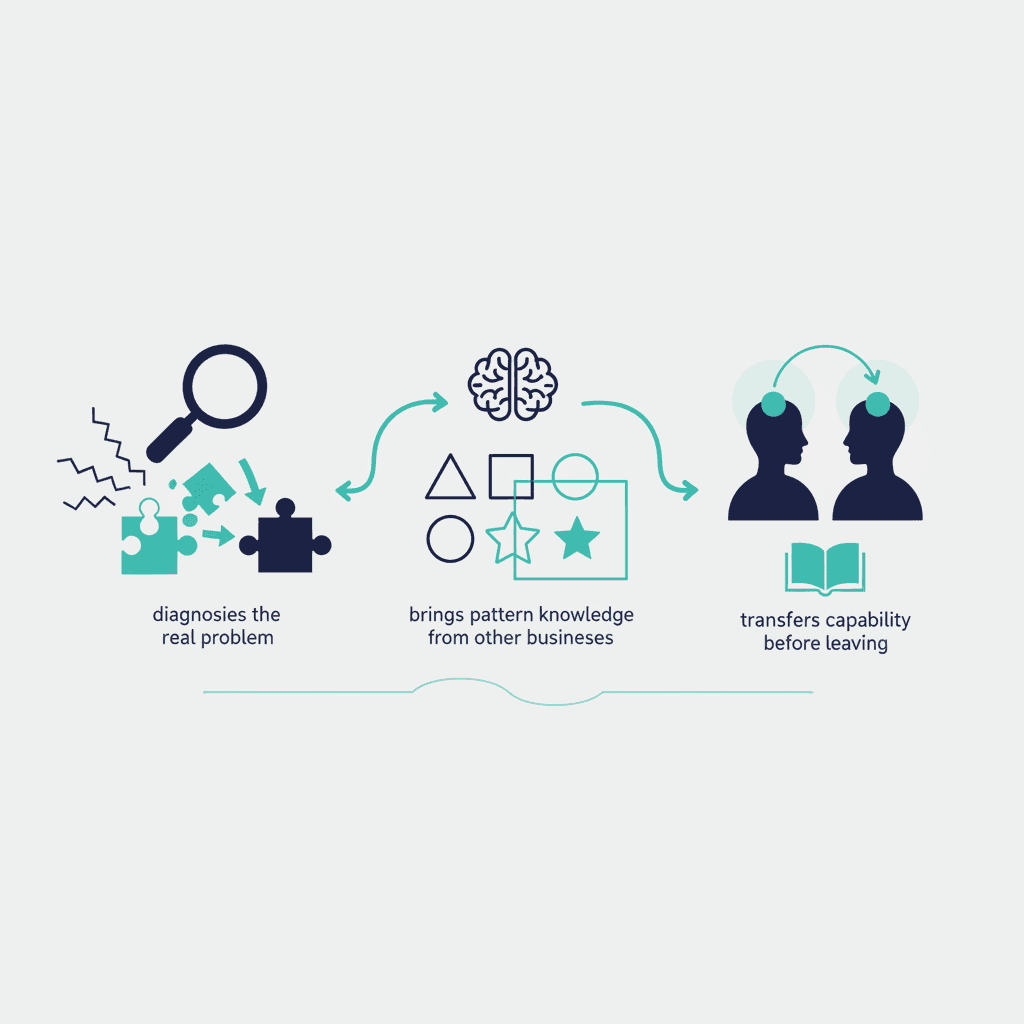
Strip away the jargon and a good business consultant does three specific things. (Not sure you need one yet? See signs your business needs a consultant first.) If the person you're evaluating can't explain their value in these terms, that tells you something.
1. Diagnosis — finding the actual problem
Most businesses ask for help with a symptom: "our sales are flat," "the team wastes hours on admin," "the website gets traffic but no enquiries." The consultant's first real job is separating the symptom from the cause — flat sales might trace to slow lead follow-up, not lead volume; wasted hours might trace to one broken handoff, not a missing tool. This is where an outside perspective earns its fee: the people inside a business have usually stopped seeing the workaround they perform every day. See The Business Losing Deals Nobody Knew About for what an undiagnosed problem actually costs.
2. Pattern knowledge — what worked elsewhere, and what didn't
A consultant who has implemented a CRM at fifteen businesses has seen fourteen mistakes you haven't made yet. That pattern library — which vendor stalls at your size, which rollout order fails, which "best practice" only works for enterprises — is the thing you genuinely cannot get in-house on your first attempt at something. It's also why generic advice is a red flag: if the recommendations would fit any business, the pattern knowledge isn't being applied to yours.
3. Capability transfer — leaving you independent
The engagement should end with your team able to run the thing without the consultant. Documentation, training, and admin access are deliverables, not favours. A consultant who builds dependence — systems only they can maintain, knowledge that lives only in their head — has converted your project into their annuity.
What a consultant should NOT be doing
Writing a long report that restates your own words back to you. Recommending the most expensive option by default. Starting work without a written scope and a defined "done." Quoting a price before understanding the problem. If you want to see what the alternative looks like in practice, we've published our entire engagement process at How We Work — free discovery call, fixed-scope proposal, milestone delivery, clean handoff.
The honest recommendation
Judge a consultant by their questions, not their pitch. In a first conversation, someone doing real diagnosis asks uncomfortable, specific questions about your numbers and process; someone selling a pre-packaged answer mostly talks. If you're evaluating candidates now, see Questions to Ask Before Hiring an AI Consultant — the vetting logic applies to any consultant, not just AI.
Frequently asked questions
Is a consultant just someone who tells you what you already know?
A bad one, yes — that's the stereotype, and it's earned in parts of the industry. A good one tells you things you don't know: what similar businesses tried, what failed and why, and which of your assumptions doesn't survive contact with data.
What's the difference between a consultant and an agency?
An agency primarily executes work you've already scoped (build this website, run these ads). A consultant helps you figure out what work is actually worth doing first — and ideally builds your team's ability to sustain it, rather than creating dependence.
How long does a typical small-business consulting engagement last?
Anywhere from a two-week audit to a few months of implementation support. Be wary of open-ended engagements with no defined end state — good consulting has a finish line written down before it starts.
Yash
Founder & Principal Consultant, Ynexgen
Yash leads Ynexgen, helping small and mid-sized businesses turn technology into a stronger foundation for growth — 7+ years across Salesforce CRM, websites, and AI adoption.