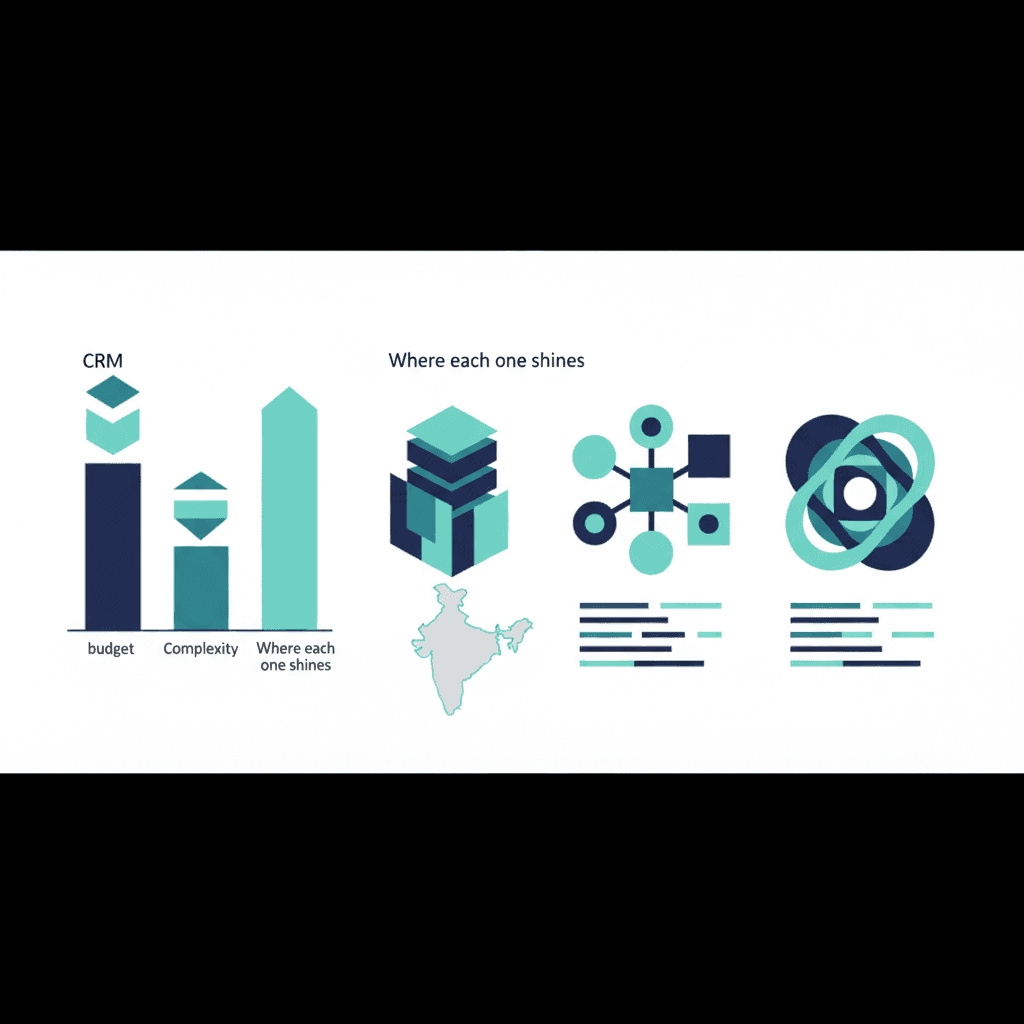
Salesforce, Zoho and HubSpot are the three CRMs we're asked about most. There's no single "best" — only the best fit for your size, budget and goals. (Current 2026 INR pricing for all of them, including Freshsales: CRM software cost in India.) Here's an honest comparison for Indian SMBs. (If you've settled on Zoho, jump to Zoho CRM pricing in India and implementation cost.)
The quick comparison
| Zoho | HubSpot | Salesforce | |
|---|---|---|---|
| Starting price | ~$9.40/user/month | Free tier, paid from ~$20/month | $25–330+/user/month |
| Best for | Value, straightforward sales | Marketing-led growth | Complex, multi-team processes |
| Setup effort | Low to moderate | Low | Moderate to high |
| India-specific fit | Strong (GST-ready billing, local support) | Neutral | Neutral, needs local partner |
| Where it struggles | Deep customisation at scale | Advanced CRM customisation | Cost and complexity for small teams |
Zoho — best value for most Indian SMBs
Zoho is an Indian product with aggressive pricing and a huge suite of connected apps. For many small businesses it offers 80% of what they need at a fraction of the cost. Zoho One bundles the CRM with 40+ other business apps (accounting, HR, inventory) for about $35/user/month — often cheaper than buying separate tools for each function. The trade-off: as you scale and customise heavily, it can get fiddly, and its interface, while functional, is less polished than HubSpot's.
HubSpot — best for marketing-led growth
HubSpot is famous for an easy, polished experience and strong marketing tools. The free tier is genuinely useful — usable long-term, not a countdown trial — and covers basic contact and deal tracking well. Watch the pricing as your contact list and feature needs grow: HubSpot's paid tiers scale by contact volume, and marketing automation features sit behind Marketing Hub specifically, not the base CRM.
Salesforce — best for scale and complex processes
Salesforce is the most powerful and customisable of the three. It shines when your processes are complex, you have multiple teams with different workflows, or you're planning to scale significantly within the next 1–2 years. It needs more setup investment than either alternative, which is where expert implementation matters most — a poorly configured Salesforce instance is worse than a well-configured Zoho one, every time.
What Indian SMBs actually pick, and why
In our experience, businesses under 20 employees with a straightforward sales process default to Zoho for cost reasons, and rarely regret it unless their process genuinely needed Salesforce's customisation from day one. Marketing-heavy businesses (agencies, D2C brands running content and campaigns) lean HubSpot for the integrated marketing tools. Salesforce shows up mostly in businesses that have already outgrown Zoho or HubSpot, or that need to match a specific enterprise customer's or investor's expectations.
Which should you choose?
- Tight budget, simple needs, want value → start with Zoho.
- Marketing-driven, want an easy start → HubSpot.
- Complex processes, multiple teams, scaling fast → Salesforce.
Whatever you pick, the tool matters less than the setup. A well-implemented Zoho beats a badly-implemented Salesforce every time. If you'd like a second opinion on your specific situation, ask us — it's free.
Frequently asked questions
Is Salesforce overkill for a small business?
It can be, if your processes are simple. Salesforce pays off when you have complexity or strong growth plans.
Can I switch CRMs later?
Yes, but migrations take effort — data, automations and training all have to move. Choose carefully up front.
Which CRM is cheapest in India?
Zoho is usually the most cost-effective for Indian SMBs, both in licensing and local support.
Yash
Founder & Principal Consultant, Ynexgen
Yash leads Ynexgen, helping small and mid-sized businesses turn technology into a stronger foundation for growth — 7+ years across Salesforce CRM, websites, and AI adoption.