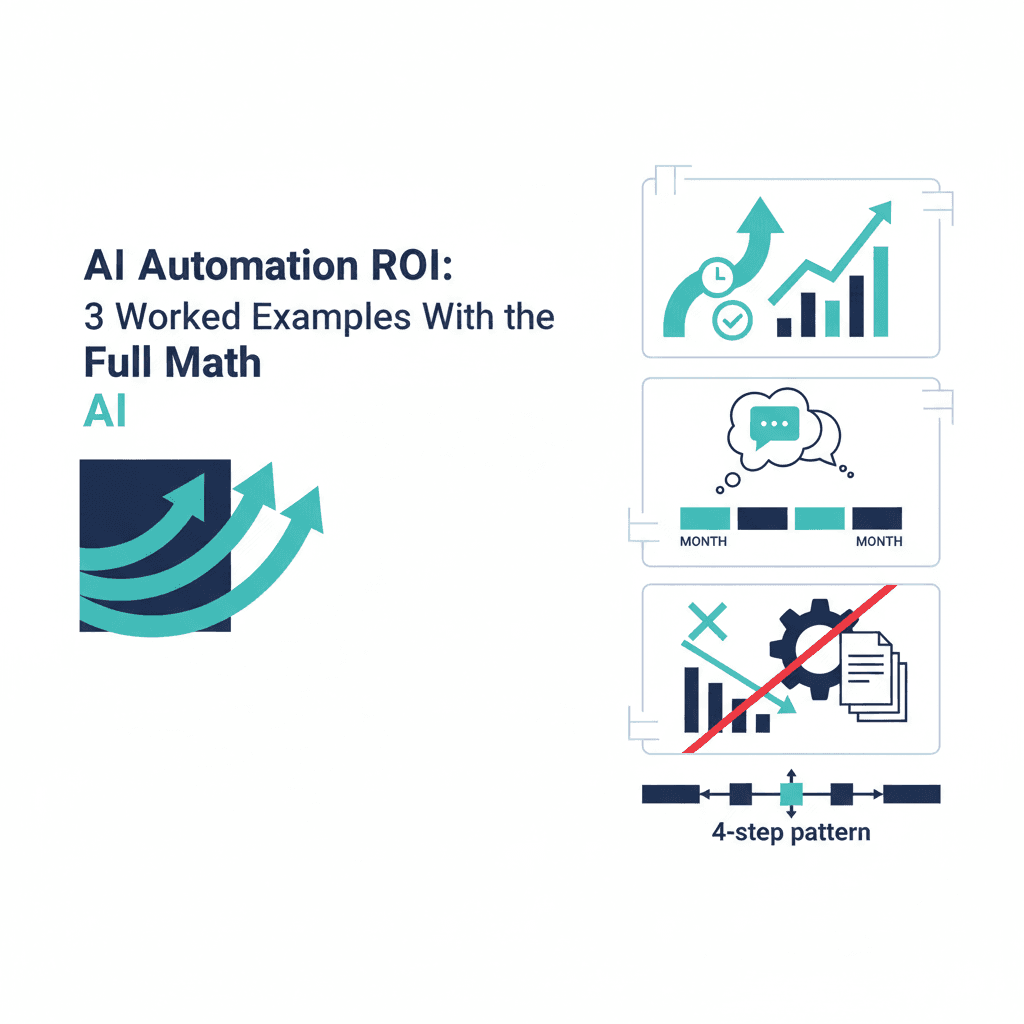
AI automation ROI stops being abstract when you run the numbers on real scenarios. Here are three worked examples with the full math — a lead-response automation paying back in ~6 weeks, a support chatbot in ~4 months, and a document-processing project that we'd advise against at the volumes shown. The pattern to steal: cost the humans honestly, cost the automation honestly (build + run), and let the payback period decide. (The measurement framework itself is in how to measure AI automation ROI — this post is the framework applied.)
Example 1: AI lead response for a 12-person services firm
Before: ~80 website/WhatsApp leads a month, first response averaging 9 working hours; the firm's own data showed leads contacted within an hour closed at roughly twice the rate. Sales admin spent ~25 hrs/month on triage (≈ $625 at a $25/hr loaded rate).
Automation: instant AI qualification + reply + CRM entry and routing. Build $4,500; running costs ~$120/month.
After the math: admin time drops to ~5 hrs/month (+$500/mo saved). Conservative revenue effect — 80 leads × 15% baseline close × $2,000 average project: even a 2-point close-rate lift ≈ $3,200/month in gross new revenue. Payback: under 6 weeks. This is why lead response is the highest-ROI first automation for most SMBs — the cost and ROI breakdown goes deeper.
Example 2: tier-one support chatbot for a subscription business
Before: ~1,100 tickets/month; 55% are password/billing/how-do-I repeats; two agents at $3,200/month loaded each, drowning.
Automation: platform AI bot trained on the help center — $2,500 setup, $350/month (platform + maintenance).
After: bot resolves ~45% of total volume (realistic against the 55% repetitive slice — vendors quoting higher assume cleaner knowledge than most companies have). That's the workload of roughly one agent; the firm redeployed rather than cut, absorbing growth without a third hire. Counting the avoided hire: ≈$2,850/month net, payback ~4 months. The tier-one automation playbook covers the design; platform pricing comparison here.
Example 3: invoice processing — the honest "don't"
Before: a bookkeeper keys ~150 supplier invoices a month into accounting software, ~4 minutes each — 10 hrs/month, ≈$300.
Automation quote: $6,000 custom document-AI pipeline + $150/month running.
The math says no: $300/month of labor against $6,000 + $150/month means payback past 3 years — before error-handling time (document AI still needs human review on exceptions). At this volume the right answer is the $30/month OCR feature already inside most accounting tools, or simply leaving it manual. Automation ROI is about volume, and 150 documents isn't it. This is the discipline in when AI automation isn't worth it — the hidden costs land hardest on thin-volume projects.
The pattern across all three
- Cost the status quo in loaded rates and hours — not gut feel.
- Cost the automation as build + run — the monthly line matters more than the quote.
- Use conservative benefit numbers (2-point lift, 45% deflection) — if it pays back conservatively, reality is upside.
- Respect the volume threshold — below it, buy a feature, not a project.
Run your own scenario in the automation ROI calculator, or book a free consultation and we'll do the math on your numbers — including telling you when the answer is Example 3.
Frequently asked questions
What AI automation has the best ROI for small businesses?
Lead response and qualification, in most cases: instant replies to enquiries measurably lift close rates (contacted-within-an-hour leads convert at roughly double the rate), the build is modest ($3,000–$6,000), and payback commonly lands in weeks. Tier-one support automation is the usual second, paying back in months at moderate ticket volume.
How do you calculate ROI on AI automation?
Four steps: cost the status quo in loaded hourly rates and hours; cost the automation as build plus monthly running costs (the monthly line matters most); apply conservative benefit numbers (a 2-point close-rate lift, 45% ticket deflection — not vendor best cases); and compute the payback period. If it pays back conservatively, reality is upside.
When is AI automation not worth it?
Below the volume threshold. A task consuming 10 hours a month (~$300 of labor) can't justify a $6,000 custom build plus $150/month running costs — payback runs past three years before error-handling time. At thin volume, buy the $30/month feature inside software you already own, or leave it manual.
Yash
Founder & Principal Consultant, Ynexgen
Yash leads Ynexgen, helping small and mid-sized businesses turn technology into a stronger foundation for growth — 7+ years across Salesforce CRM, websites, and AI adoption.