Solo and small-firm attorneys ask this on r/LawFirm every few weeks, and the answers rarely agree: one thread has a firm questioning a $6,000 quote for "a basic website," another has someone "shocked" by an $8,000 average across bids, a third is weighing a $10,000+ proposal against a law student who built a classmate's site for $3,000. None of those numbers is wrong — they're quotes for different things wearing the same label.
Here's the actual range, and what moves a quote from one end to the other.
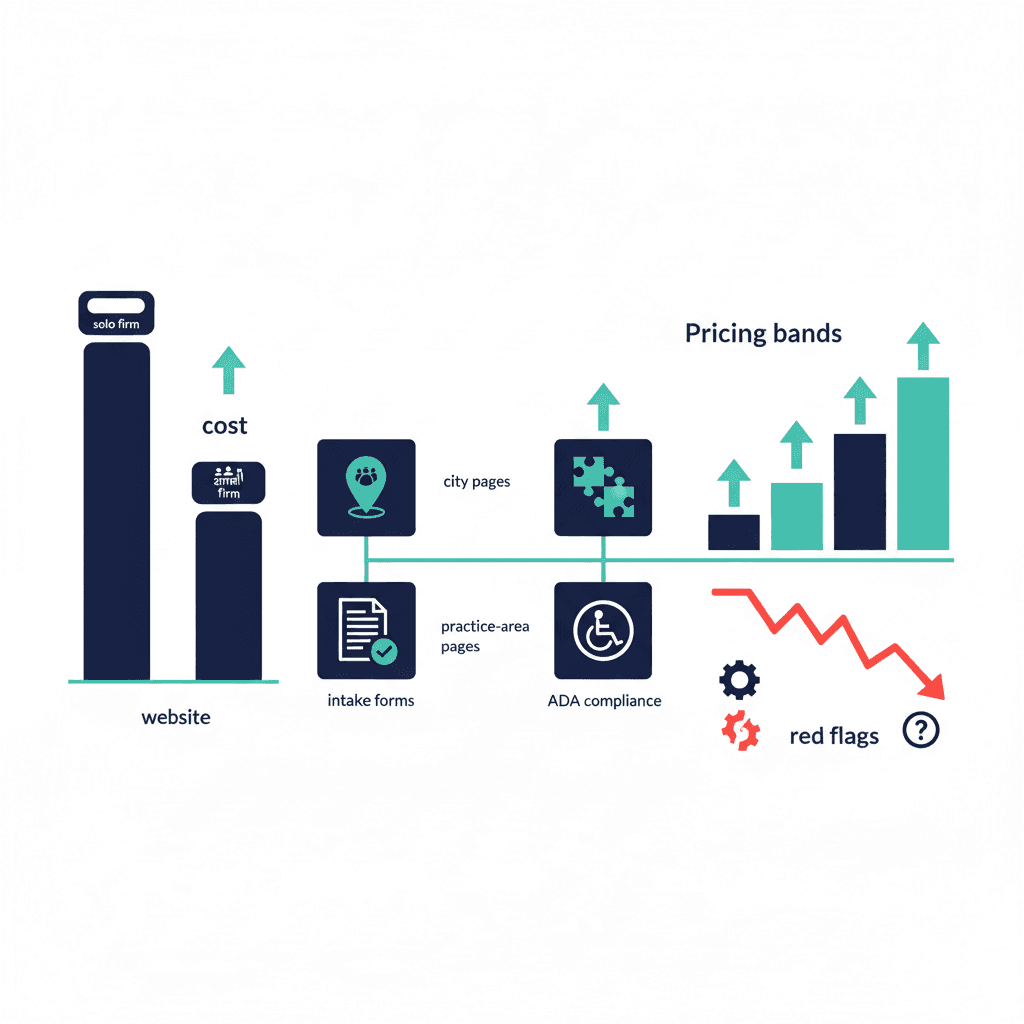
Law firm website pricing bands
| Tier | Typical range | What you get |
|---|---|---|
| Template / DIY | $500 – $2,000 | Squarespace or a legal-specific template (Clio Grow, FindLaw templates), a handful of pages, self-managed |
| Professional, custom-built | $3,000 – $8,000 | Custom design, 5–10 pages, attorney bios, practice-area pages, contact/intake form, basic on-page SEO |
| Multi-attorney firm, content-heavy | $8,000 – $20,000+ | Everything above plus a blog/content system, city + practice-area landing pages built for local SEO, more complex intake logic, ongoing content |
Two threads in the r/LawFirm quotes above land inside the middle band and aren't unreasonable for what a custom build actually involves — the frustration is usually that nobody explained why the number is what it is.
What pushes a quote toward the high end
Number of practice-area pages. A personal injury firm covering car accidents, slip-and-fall, medical malpractice and wrongful death needs four distinct, well-written pages that each target their own search terms — not one generic "personal injury" page. Each one is real writing and SEO work, not a template swap.
City-level pages, if you serve more than one location. A firm with offices in two cities, or one that wants to rank in five surrounding towns, needs a page per city-plus-practice-area combination to show up in local search. This is the single biggest line-item difference between a $4,000 quote and a $12,000 one, and it's also the item most often left out of a vague quote until later.
Intake form complexity. A basic "name, email, message" contact form is a small add-on. A qualifying intake form — case type, incident date, prior representation, jurisdiction — that routes to different attorneys or triggers a conflict check is real logic work, and should be scoped and priced as such.
Attorney bio pages, done properly. Bar admissions, case results (where your state's advertising rules allow listing them), education, and a professional photo shoot. Bio pages matter more for law firms than almost any other SMB category — clients are hiring a person, not a brand — and they take real content work to do well.
Blog/content setup. If part of the pitch is ongoing content for SEO, that's a recurring cost, not a one-time build fee — make sure a quote is clear about which one you're paying for.
The item most quotes leave out: ADA compliance
This is the one that's genuinely different for law firms versus most small businesses. Law firms are disproportionately targeted by ADA website accessibility demand letters and lawsuits — plaintiffs' firms that specialize in this litigation know that other law firms are a soft target, and "the lawyer's own website wasn't accessible" makes an easy, embarrassing case. A quote that never mentions accessibility (alt text, keyboard navigation, color contrast, WCAG 2.1 AA as a baseline) isn't automatically dishonest, but it's a gap you should ask about directly before signing.
What ongoing hosting and maintenance should cost
Budget $50–$200/month for hosting, security updates, backups and basic uptime monitoring on top of the build price. Below $50/month, ask what's actually included — cheap hosting with no one watching it is how firms end up finding out their site went down three weeks ago. Above $200/month without active content work (new blog posts, added pages) being part of the retainer, ask what the fee is actually buying.
Red flags in a law firm website quote
- No mention of practice-area or city-page count — "a website" isn't a spec; the number of pages and what each one needs to rank is the actual scope.
- No accessibility statement at all — not necessarily disqualifying, but worth a direct question given the litigation exposure above.
- A single flat number with no breakdown — you can't tell if you're paying for 5 pages or 20, or whether SEO and content are included or extra.
- No maintenance plan offered — means you're on your own for security patches and backups the day the invoice is paid.
- A price that seems too good relative to page count and SEO promises — a $1,500 "custom SEO-optimized 15-page site" usually means a template with your logo swapped in and no actual keyword research behind the page structure.
Getting an apples-to-apples quote
Before you ask for pricing, write down: how many practice areas, how many cities/locations, whether you want ongoing content, and what your intake form actually needs to capture. A quote built against that list is comparable to another quote built against the same list — which is the comparison none of those Reddit threads could actually make, because everyone was pricing a different scope under the same word, "website."
If you want a second opinion on a quote you've already got, or a scoped estimate for your specific practice areas and locations, that's exactly what a free conversation with our website development team is for — we'll tell you honestly if a number looks reasonable, not just take the job.
Website cost guides for other industries
- Realtor websites & IDX fees
- Nonprofit websites
- Chiropractor websites vs. Google Maps
- Restaurant websites vs. Google Business Profile
- Etsy vs. your own website
- Tradesperson websites (electricians, HVAC, plumbers)
- Dental practice websites
- Therapist websites (HIPAA-aware)
- Mobile detailing websites vs. Google Business Profile
- Roofing company websites
- Home inspector websites
- Bookkeeper & accountant websites
- Landscaping & lawn care websites
- Wedding vendor websites (photographers, planners)
- Moving company websites
Or see the general website cost breakdown that applies across all of them.
Frequently asked questions
Why do law firm website quotes vary so much?
Because "a website" isn't a fixed scope — the number of practice-area pages, whether you need city-level pages for local SEO, intake form complexity, and whether ongoing content is included all change the price. A $3,000 quote and a $10,000 quote are often pricing genuinely different amounts of work, not the same thing at different markups.
Do I need a custom-built site, or is a template fine?
A template ($500–$2,000) works for a solo practitioner who needs a credible online presence and isn't relying on the site to generate leads. If you're competing for search visibility in a specific practice area and city, a custom build with dedicated practice-area and location pages performs meaningfully better in local search — that's where the $3,000–$8,000 tier earns its price.
How much should ongoing hosting and maintenance cost?
$50–$200 per month for hosting, security updates, backups and uptime monitoring, separate from the build cost. Below that range, confirm what's actually being monitored; above it, confirm the fee includes active work like new content, not just hosting.
Does my law firm website need to be ADA compliant?
Law firms are a frequent target of ADA website accessibility demand letters and lawsuits, partly because plaintiffs' firms know other law firms make easy, high-visibility cases. There's no absolute legal requirement that applies identically everywhere, but building to WCAG 2.1 AA as a baseline (alt text, keyboard navigation, sufficient color contrast) is standard risk management any firm should ask its developer about directly.
What should I have ready before asking for quotes?
A list of your practice areas, the cities or regions you want to rank in, whether you want an intake form that qualifies leads (case type, incident date, jurisdiction), and whether you want ongoing blog content. A quote built against that list is the only way to compare two firms' pricing fairly.
Yash
Founder & Principal Consultant, Ynexgen
Yash leads Ynexgen, helping small and mid-sized businesses turn technology into a stronger foundation for growth — 7+ years across Salesforce CRM, websites, and AI adoption.