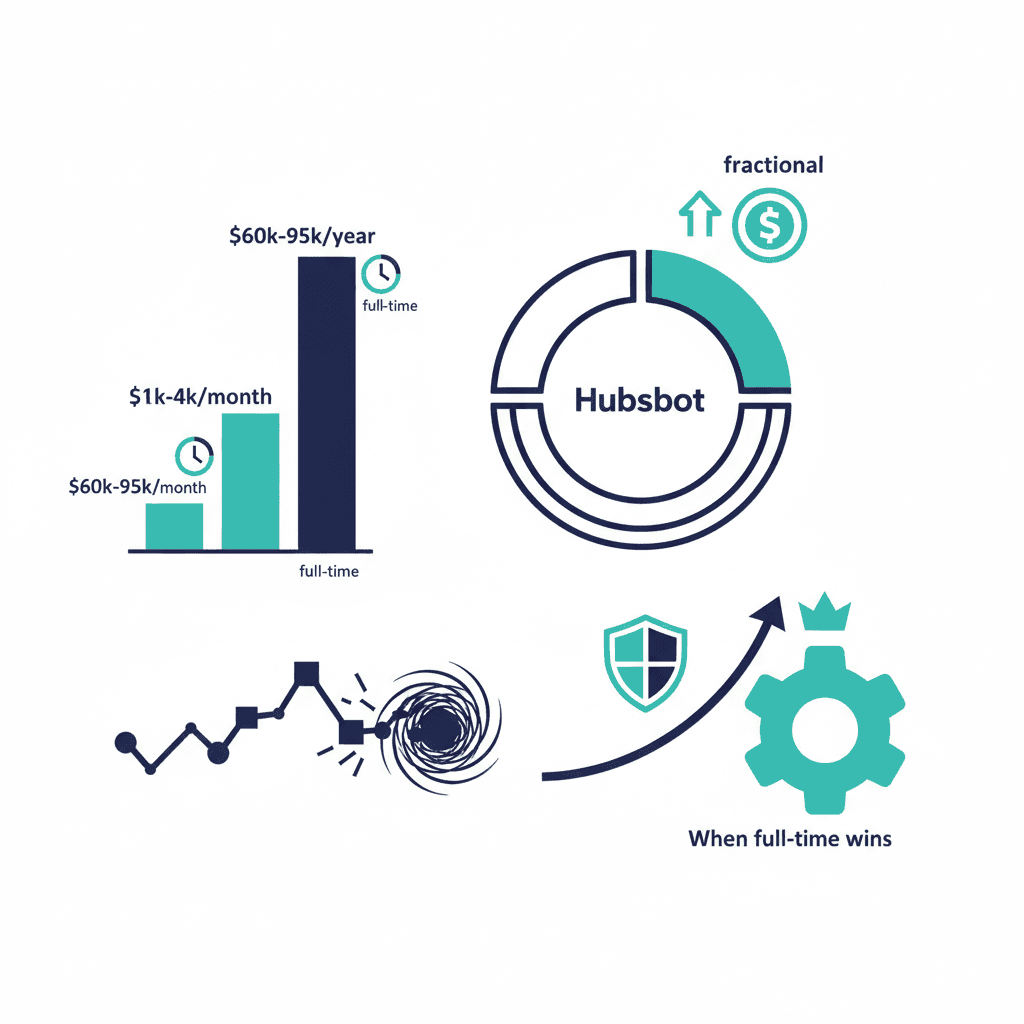
A fractional HubSpot admin typically costs $1,000–$4,000 per month on retainer for 10–40 hours — against $60,000–$95,000 a year loaded for a full-time HubSpot administrator. It's the same math that made fractional Salesforce admins a standard SMB move, applied to a platform that's easier to run but just as easy to let rot. Here's what the retainer buys, what it costs by tier, and when full-time genuinely wins.
Cost by tier
| Retainer | Hours/month | Typical cost | Fits |
|---|---|---|---|
| Light | ~10 | $1,000–$1,500 | Hygiene: lists, workflows, permissions, reporting upkeep |
| Standard | ~20 | $1,800–$2,800 | Active improvement: new automations, integrations, campaign ops |
| Heavy | ~40 | $3,000–$4,000+ | Near-half-time: migrations, RevOps buildout, multi-hub rollouts |
HubSpot admin rates run modestly below Salesforce equivalents ($1,500–$5,000 for the same bands) because the platform's admin surface is smaller — there's no Apex, fewer permission layers, and Ops Hub covers what custom code often does in Salesforce.
What a HubSpot org actually needs monthly
HubSpot sells itself as self-serve, and for month one it is. By month twelve, the typical SMB portal has: duplicate contacts eroding every report, workflows nobody remembers building (firing emails nobody audits), lifecycle stages used three different ways by three teams, and an integration that silently stopped syncing in March. None of this needs a full-timer — it needs a few disciplined hours every month with clear ownership. That's the fractional case, and skipping it is how companies end up in the 91% that have a CRM but don't get value from it.
Fractional vs full-time vs agency
- Fractional wins for most SMBs under ~50 staff: senior skills, no benefits/recruiting overhead, and honest capacity matching — most portals genuinely need 10–20 hours a month, not 160.
- Full-time wins when HubSpot is your operating system — multi-hub (Marketing + Sales + Service + Ops), heavy campaigns weekly, revenue team over ~20 people.
- Agency retainers overlap with fractional but bundle strategy/creative; if you only need the portal run well, a fractional admin is the cheaper, more accountable shape. The consultant vs employee math applies cleanly here.
What to insist on in a retainer
A named admin (not a rotating pool), a monthly report tied to your numbers (list health, workflow audit, pipeline hygiene — not hours logged), documented changes, and no long lock-in. If you're choosing between platforms first, start with Salesforce vs HubSpot — the admin-cost difference above is part of that total-cost picture.
We run fractional admin retainers across HubSpot, Salesforce and Zoho — book a free consultation and we'll audit your portal's actual monthly need before quoting a single hour.
Frequently asked questions
How much does a fractional HubSpot admin cost?
Typically $1,000–$4,000 per month depending on hours (10–40/month) and seniority: light hygiene retainers run $1,000–$1,500, active-improvement retainers $1,800–$2,800, and near-half-time engagements $3,000–$4,000+. That's modestly below fractional Salesforce rates because HubSpot's admin surface is smaller.
Does a small business really need a HubSpot admin?
Not a full-time one, usually — but someone must own the portal. Within a year, unowned portals accumulate duplicate contacts, forgotten workflows still firing emails, inconsistent lifecycle stages and silently broken integrations. Ten to twenty disciplined hours a month prevents the decay that turns a CRM into overhead.
When should a company hire a full-time HubSpot admin instead?
When HubSpot is the company's operating system: multiple hubs in active use (Marketing, Sales, Service, Ops), weekly campaign operations, and a revenue team past roughly 20 people. Below that, most portals genuinely need 10–20 hours a month, which is exactly what a fractional retainer prices.
Yash
Founder & Principal Consultant, Ynexgen
Yash leads Ynexgen, helping small and mid-sized businesses turn technology into a stronger foundation for growth — 7+ years across Salesforce CRM, websites, and AI adoption.