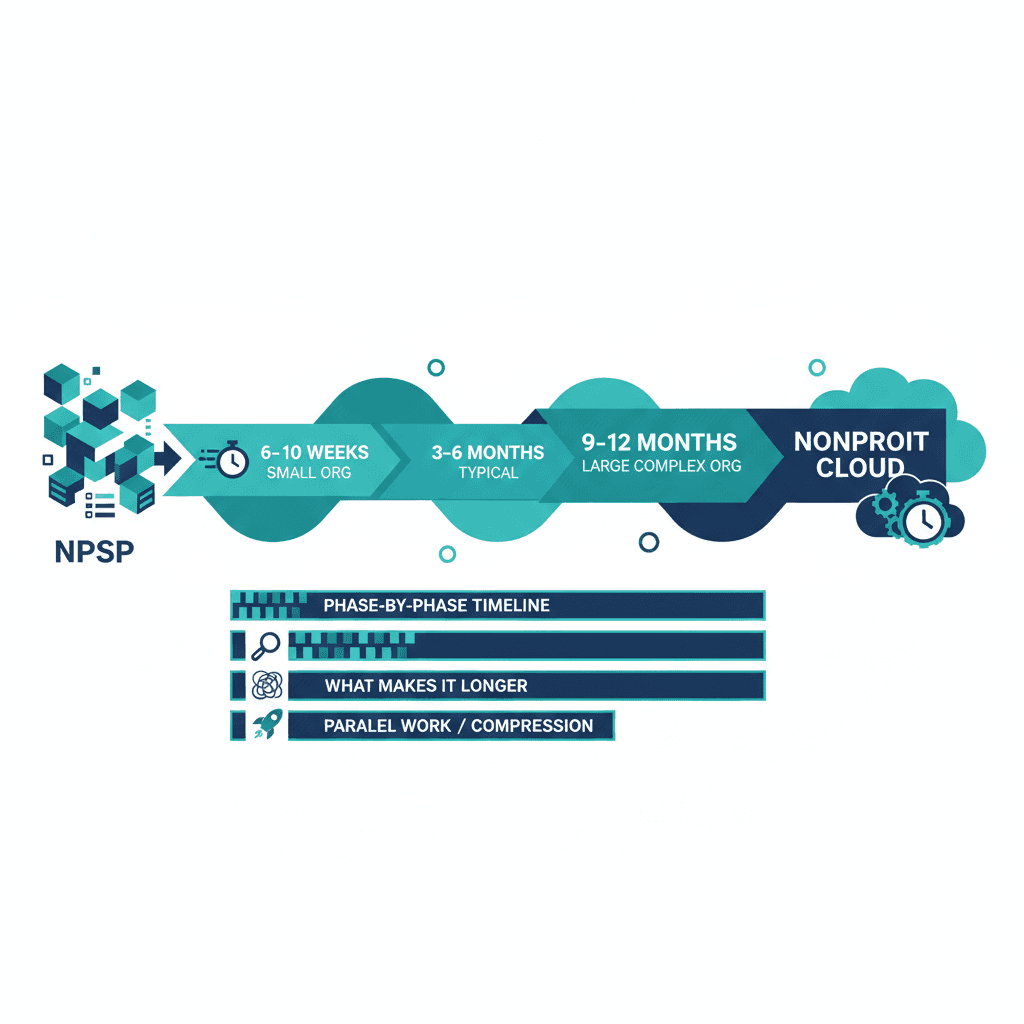
Most NPSP to Nonprofit Cloud migrations take three to six months from kickoff to go-live. A small organization with clean data can be done in six to ten weeks; a large nonprofit with heavy customization plus native program and case management can run nine to twelve months.
The duration is driven far more by your org's complexity than by the size of your donor database — a clean 200,000-contact org often moves faster than a messy 20,000-contact one with a decade of custom automation.
There's a second answer that matters just as much, and almost nobody gives it: the calendar constrains your go-live date more than the work does. A four-month project can still take nine calendar months of waiting if the build finishes in October, because no nonprofit should cut over its fundraising database in November. That section is further down, and it's the part that changes real project plans.
Want an estimate for your org? The Salesforce implementation timeline estimator includes a Nonprofit Cloud option and gives you a phase-by-phase range in about a minute.
Timeline by organization profile
| Org profile | What puts you here | Typical duration |
|---|---|---|
| Small / clean | Under ~25,000 contacts, close-to-standard NPSP, little or no custom Apex, one or two integrations, no program management | 6–10 weeks |
| Mid-sized | 25,000–150,000 contacts, some custom objects and automation, three to five integrations, real reporting dependencies | 3–5 months |
| Large / complex | Heavy customization and custom Apex, many integrations, a first-time program/case/grantmaking build, multiple teams to train | 9–12 months |
If you're not sure which row you're in, the honest test isn't your contact count — it's this: can one person in your organization explain every automation currently running in your NPSP org? If nobody can, you're at least mid-sized on this table regardless of database size, because discovery has to reconstruct that knowledge before anything else can start.
Where the time goes, phase by phase
| Phase | Duration | What drives the range |
|---|---|---|
| 1. Discovery and audit | 2–4 weeks | How much of your org is documented, and how much has to be reverse-engineered |
| 2. Design and data mapping | 2–6 weeks | The Household-to-Person-Account conversion, soft credits, relationship modelling |
| 3. Build and configuration | 3–10 weeks | Automation rebuild volume, plus any net-new program or grantmaking modules |
| 4. Data migration and testing | 2–6 weeks | Data quality, reconciliation failures, number of staged loads needed |
| 5. Training and go-live | 1–3 weeks | Team size, role variety, whether you run parallel before cutover |
Two things to read carefully in that table.
First, the phases overlap in practice. Build usually starts before mapping is fully signed off, and training material gets written during testing. Adding up the top of every range gives you 29 weeks, which is why the honest headline is "three to six months" rather than "up to seven."
Second, phase 2 is where migrations quietly go wrong. Mapping Households to Person Accounts is the one phase where rushing doesn't show up until testing, when giving totals don't reconcile and you can't tell whether the problem is the load or the model. Teams that spend an extra week on mapping routinely save three in phase 4.
The nonprofit calendar: the constraint nobody scopes for
Commercial CRM migrations can go live more or less whenever the build is ready. Nonprofits can't, and this is the single most common reason a migration that was "nearly done" sits unfinished for months.
There are windows in a nonprofit year when you must not cut over your system of record:
- Giving season (roughly November to early January). A large share of annual individual giving arrives between GivingTuesday and December 31. Cutting over during that window means processing your highest-volume, highest-stakes gifts on a system your team learned three weeks ago, with no established baseline to reconcile against. Treat mid-October to mid-January as closed.
- The six weeks before fiscal year end. Many nonprofits run a June 30 or March 31 year end. Year-end reporting needs a stable, reconcilable system — not one mid-conversion.
- Audit fieldwork. Your auditors will ask for donation records and reconciliations covering the prior year. That's far easier when the data hasn't just moved between two structurally different account models. If audit is in the calendar, go live well clear of it.
- Your own campaign and giving-day dates. A giving day is a volume spike with a hard deadline and public visibility. Same logic as giving season, compressed into 24 hours.
- Major grant reporting deadlines. If program data feeds a funder report, don't be migrating program objects the month it's due.
Put those together and most organizations have two realistic cutover windows a year — broadly late winter to spring, and mid-summer to early autumn, shifted by your own fiscal year. That's the practical answer to "how long will this take": the build takes three to six months, and then it goes live at the next open window.
Working backwards from a go-live date
Because the windows are fixed, plan in reverse rather than forward:
- Pick the cutover window first, using the constraints above.
- Subtract two to three weeks for training and go-live.
- Subtract four to six weeks for data migration and testing — the phase that most often overruns, so give it its full range rather than its optimistic end.
- Subtract your build estimate from the profile table.
- Subtract four to ten weeks for discovery, design and mapping.
- Whatever date that lands on is your real kickoff. If it's already behind you, you're aiming at the following window — and the right move is to spend the intervening months on the prep below, not to compress testing.
An organization wanting to go live in July, in other words, is typically starting discovery in January or February. Nonprofits that discover this in May usually end up going live the following spring.
What makes it take longer
- Dirty data. Cleanup can add weeks — and it has to happen either way, so start it before the project does.
- Custom Apex and complex automation. Each piece is a rebuild-or-replace decision plus testing, and the decision needs someone who knows why it was built.
- Integrations that resist re-pointing. Accounting, payment and email connections all need re-testing against the new org, and vendor support timelines are outside your control.
- First-time program or case management. That's a net-new build sitting on top of the migration, not part of it — the biggest single reason orgs land in the 9–12 month band.
- Decision latency. Migrations stall waiting for answers about how your organization actually wants to model constituents. Name one internal decision-maker who can settle those questions in days, not weeks.
What you can do in parallel to compress it
Data cleanup, documenting your must-keep customizations, and verifying that critical apps support Nonprofit Cloud can all happen before kickoff. Organizations that do this prep often shave a month off the timeline and reduce the cost at the same time, because discovery and data mapping both move faster against a documented, deduplicated org. The readiness checklist is that prep list.
What you can't compress is testing and reconciliation. It's the phase under most schedule pressure and the one where cutting time causes damage you find out about months later, in an audit or a year-end report.
What "go-live" doesn't include
The three-to-six-month figure ends at cutover. Budget an additional two to four weeks of hypercare — elevated support while your team hits real edge cases in real work: an unusual recurring gift, a soft credit that doesn't look right, a report someone relied on that nobody mentioned in discovery.
Plan for it explicitly. Organizations that treat cutover as the finish line tend to spend that month in unplanned firefighting instead, which is the same time cost with more stress and less confidence.
If you want dates scoped against your own org's shape rather than a range, our Salesforce consulting team plans nonprofit migrations end to end — and choosing the right partner covers what to ask before you sign. Still deciding whether to move at all? NPSP vs Nonprofit Cloud is the head-to-head comparison, and should you migrate now or wait is the timing framework.
Frequently asked questions
How long does an NPSP to Nonprofit Cloud migration take?
Most take three to six months from kickoff to go-live. A small organization with clean data can finish in six to ten weeks; a large nonprofit with heavy customization plus native program and case management can run nine to twelve months. Complexity matters more than database size.
What are the phases of an NPC migration?
Discovery and audit (2–4 weeks), design and data mapping (2–6 weeks), build and configuration (3–10 weeks), data migration and testing (2–6 weeks), and training and go-live (1–3 weeks). The phases overlap, so the totals don't simply add up. Data mapping is driven by the Household-to-Person-Account conversion.
Can we speed up the migration?
Yes — clean your data, document must-keep customizations, and verify critical apps support Nonprofit Cloud before kickoff. Organizations that do this prep often shave a month off the timeline and reduce cost, because discovery and data mapping move faster. What you should not compress is testing and reconciliation.
When should a nonprofit go live on Nonprofit Cloud?
Avoid cutting over between mid-October and mid-January (giving season), in the six weeks before fiscal year end, during audit fieldwork, or near a giving day or major grant reporting deadline. That leaves most nonprofits two realistic cutover windows a year — broadly late winter to spring, and mid-summer to early autumn, shifted by your own fiscal year.
When should we start if we want to go live in a specific month?
Work backwards: two to three weeks for training and go-live, four to six weeks for data migration and testing, your build estimate, then four to ten weeks for discovery and mapping. An organization aiming to go live in July is typically starting discovery in January or February.
Is the migration finished at go-live?
No. Budget an additional two to four weeks of hypercare after cutover, while your team hits real edge cases in real work — unusual recurring gifts, soft credits that look wrong, or a report nobody mentioned during discovery. Organizations that treat cutover as the finish line spend that month firefighting instead.
Yash
Founder & Principal Consultant, Ynexgen
Yash leads Ynexgen, helping small and mid-sized businesses turn technology into a stronger foundation for growth — 7+ years across Salesforce CRM, websites, and AI adoption.